Pizza Origin: The True Story (Naples, 1889)
Naples, 1780s: a street vendor, a suspicious tomato, and the birth of pizza. Then 1889 — the queen, the letter, and the forgery that sold a million pies.

The last croissant sold on a Thursday. I watched it go — a woman in a gray coat, takeout box, walking out into the rain like she was carrying something fragile. Twenty-seven layers, gone in six bites, probably. That's the job. You build it for three days and it dies in six bites.
What a week, though. Monday I called the dairy supplier and doubled the butter order — he laughed, then stopped laughing when I read him the number. By Wednesday we were serving croissants as dessert at dinner, split and filled, with sauce, and people were ordering them after steak like that was a perfectly normal thing to do. And every morning at seven, my sous-chef stood outside in the cold with a tray of croissants and little to-go coffees, flagging down commuters. Forty a day, given away free. The lunch line noticed.
Marco has gotten good at lamination. Scary good. On his last tray the layers were so even I accused him of using a ruler. He said, "Your hands are the ruler," which is either the smartest thing he's ever said or he's mocking me. Both can be true.
And then there was the other thing. The thing I'm not writing down properly yet. One of my chefs was reading the book — my book, the basement book — and nothing happened to him. No smoke, no century-hopping, no blistered pages. He just read it. Like a book. I have to look further down about this matter.
Friday morning I took the croissant board down and stood there with the chalk in my hand, blank. The book decides. It always decides. I went downstairs — and I checked the third shelf first, before anything else. It was there. Exactly where it lives. That's starting to bother me more than if it had moved.
The basement smelled like woodsmoke. That's new. The book was open — third shelf, behind the water heater, exactly where it lives — and the page facing up was blistered. Not burned. Blistered, like a crust that's spent ninety seconds in a hot oven. Little leopard spots across the paper. In the margin, in handwriting I hadn't seen before, one word: pizza.
I touched the page. The smoke smell got stronger.
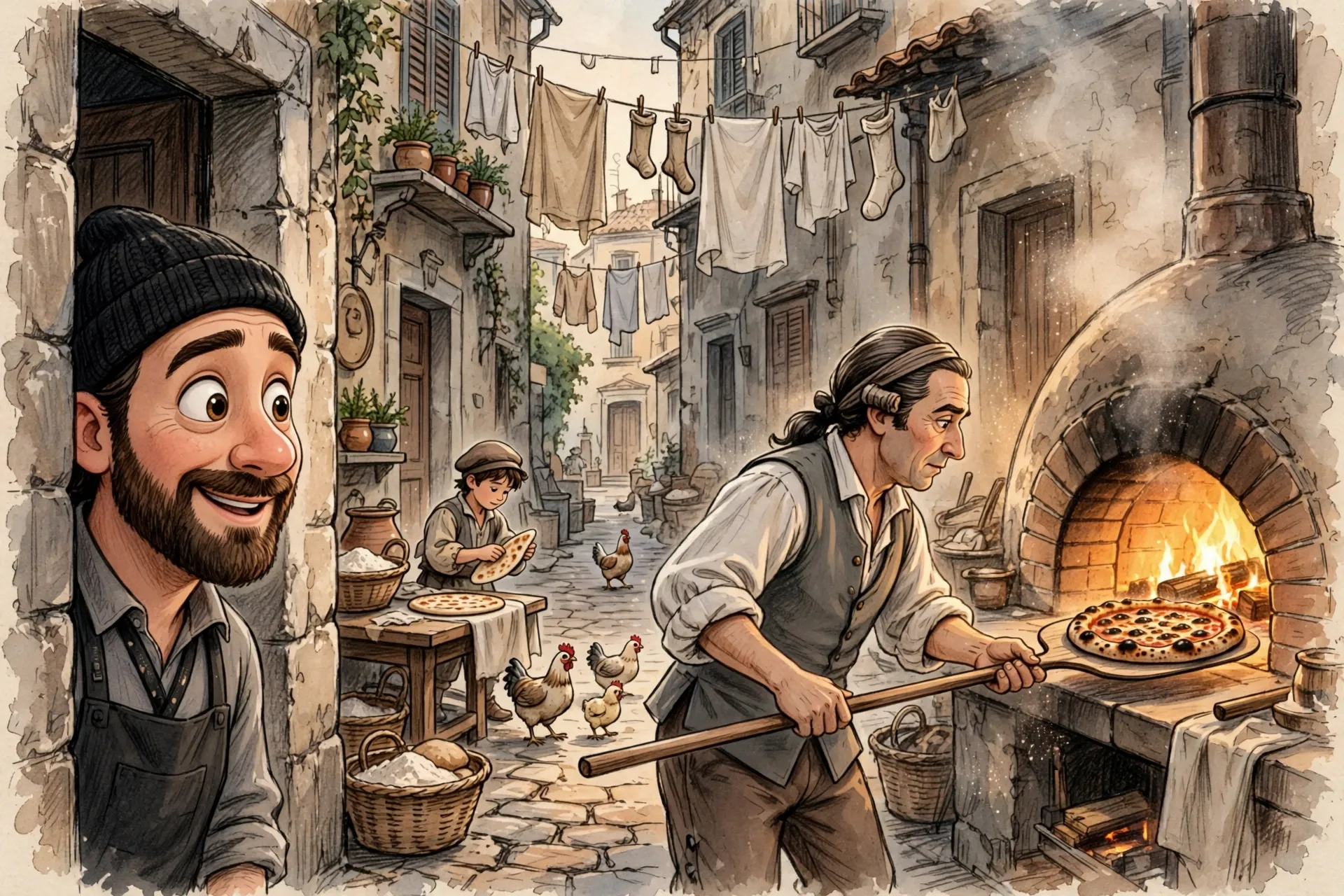
Then I was standing in an alley in Naples, and it was 1780-something, and a man was slapping dough against a wooden counter like he was angry at it.
The street
Naples first. Always Naples first.
The alley was narrow and loud — chickens, a blacksmith, somebody yelling about fish. The man with the dough was working out of a doorway with a brick oven behind him, and the oven was barely an oven, more of a hot cave. He stretched a disc of dough with his fists, moving fast, and the whole thing took maybe a minute. Lard. Salt. Garlic. Into the heat. Out again, blistered and steaming. A boy who couldn't have been older than ten paid with a coin, folded it in four, and ate it walking.
That was pizza. No tomato. No cheese. No basil. Just bread, fat, and salt — food for the lazzaroni, Naples' street poor and beggars, who needed something cheap, fast, and filling enough to keep them upright through a day of hauling.
I asked the vendor — my Italian in the book is better than my Italian awake — when the tomatoes went on. He laughed. Tomatoes? Nobody sane ate tomatoes. Everybody knew tomatoes were poison. They were a curiosity from the Americas, pretty and red and possibly lethal, the kind of thing you grew in a garden to frighten your neighbors. The poor of Naples were the first people in Europe to look at the feared tomato and think: what if we just... ate it? Hunger is a better scientist than fear.
That happened late in the 1700s. Tomato met flatbread in the poorest streets of Naples, and the modern pizza was born — not invented, exactly. Assembled. Out of poverty and a suspicious fruit.
The vendor's boy came back for a second one. This time the man spooned something red onto the dough before it went in. The boy saw me staring and grinned with red teeth.
The palace
June 1889. The book skipped a century like it was nothing, and suddenly I was clean, which meant trouble — the book only bothers making me presentable when there's an audience.
Capodimonte. The royal palace above Naples. Queen Margherita of Savoy was in residence — alone; the king wouldn't arrive until the morning of June 11 — and the city's most famous pizzaiolo had been summoned: Raffaele Esposito, owner of the Pizzeria della Regina d'Italia — the Queen of Italy Pizzeria.
I want you to notice that name. He'd already named his pizzeria after the queen. In 1883 — six years before any of this happened — he'd bought an existing pizzeria and renamed it for her.
Esposito made three pizzas for the queen. The story every tourist guide tells goes like this: the first two change with the telling — lard in one version, tiny fish in another. But every version agrees on the third: tomato, mozzarella, and basil — red, white, and green, the colors of the Italian flag, the colors of the new unified Italy. The queen, bored to death of French court food, loved the third one. Esposito named it after her. The Pizza Margherita was born, and a peasant street food became a royal delicacy in a single afternoon.
I watched it happen. The queen was charming. Esposito was smoother than olive oil. The pizza was beautiful. And the whole time, standing in the corner in borrowed clothes, I had the strangest feeling I'd already eaten that exact pizza — a hundred years earlier, in an alley, from a man who was angry at dough.
Because I had. The boy with the red teeth ate tomato, mozzarella, and basil in the 1780s. The "new" pizza Esposito served the queen wasn't new at all.
Here's what the tourist guides don't tell you: thirty-six years before that palace afternoon, the Neapolitan writer Emanuele Rocco contributed an essay to Francesco de Bourcard's Usi e costumi di Napoli (1853). In it, he described a pizza topped with — quote — "basil, mozzarella, and tomato." 1853. The Margherita existed before Margherita. Somebody just hadn't put a crown on it yet.
And the famous thank-you letter — the one from the royal household, the proof, the document Pizzeria Brandi still shows visitors? An American researcher named Zachary Nowak compared the handwriting to the actual head of the royal table service, a man named Galli. It didn't match. The seal was wrong — stamped and crooked, matching none of the official seals of the era. There was no record of any such letter in the royal archives (though Nowak allows the archive entry could simply be an oversight), and the semi-official Agenzia Stefani dispatches covering the whole royal visit mention no pizzaiolo. And the letter was addressed to "Raffaele Esposito Brandi" — except European men didn't take their wives' surnames. Nowak calls this a conjecture, not proof — but the two people who could have carried that combined name in that era were Giovanni and Pasquale Brandi, Esposito's wife's nephews. The same nephews who took over the pizzeria in 1932.
You see where this is going. The queen's pizza was probably never the queen's pizza. It was a brilliant piece of marketing, possibly forged a generation later by two nephews who understood that a royal blessing sells more pies than a street vendor ever could.
Oh — and one more theory, my favorite: margherita means "daisy" in Italian. One folk theory says the pizza was named for the daisy-like arrangement of mozzarella on top. A flower, not a queen. No historian has put their name to it, but I like it anyway.
Esposito bowed to the queen. The queen smiled. I stood in the corner thinking about the boy with red teeth, a century gone, who never got a plaque.
The coal oven
New York. 1905. Spring Street, Little Italy.
The smell hit first — coal smoke and baking dough, completely different from Naples woodsmoke. Gennaro Lombardi's grocery store at 53½ Spring Street had a line out the door at lunch, and the men in line were factory workers, not kings. They bought tomato pies wrapped in paper and tied with string and carried them to job sites. That was the whole business model: pizza as a workingman's lunch, same as Naples, new continent.
Here's the thing about American pizza: it couldn't be Neapolitan pizza, because New York didn't have what Naples had. No wood-fired dome ovens — the immigrants rented time in bakery ovens, huge coal-fired caverns that ran even hotter than wood. No mozzarella di bufala — they used fior di latte, cow's milk mozzarella. The pies came out bigger, built to feed several people instead of one. Adaptation wasn't a choice; it was the only equipment available.
Daniel's rule of kitchens: you don't cook the dish you remember. You cook the dish your oven allows.
One of Lombardi's men was Antonio "Totonno" Pero, a baker from Naples. In 1924 he'd leave, follow the subway lines out to Coney Island, and open Totonno's — still coal-fired a century later, though it's had its wobbles: closed during COVID, reopened in fits and starts, and in 2024 the owners started looking for a buyer. I respect the commitment.
For decades, pizza stayed inside Italian neighborhoods. Then the war accelerated everything: American GIs came home from Italy in 1945 with a taste for it — though the roots were already planted by decades of immigration — and on September 20, 1944, the New York Times gave the word its first real popularization push far outside Little Italy. From there: the chains, the frozen aisle, the delivery box. Naples invented it. America scaled it. The world ate it.
The record
The word. The oldest widely accepted written use of "pizza" isn't from Naples at all — it's from Gaeta, up the coast, in the year 997. The Codex Diplomaticus Cajetanus, a collection of medieval notarial acts, records a rent contract: a tenant owes the local bishop, every Christmas and every Easter, duodecim pizze — twelve pizzas — plus a pork shoulder and a kidney at Christmas, a couple of chickens at Easter. It's exactly the kind of thing that delights me: the first pizza in recorded history appears as rent. As an obligation. As taxes, but delicious.
What those 997 pizzas actually were, nobody knows. Probably flatbreads. The word's etymology is a three-way fight: Treccani's dictionary ventures only a tentative Langobardic bizzo — "a bite, a piece of bread" — and lists dialectal pinza as a variant, not a source. The Latin pinsere (to pound, stamp) and Greek pitta derivations circulate online. Pick your fighter; the documents don't settle it.
The ancient flatbreads. Legend says Persian soldiers under Darius the Great, 6th century BCE, baked flatbread with cheese and dates on their shields — a great story with no ancient source behind it. The Greeks made plakous — but that was a honey-and-cheese flat cake, a cheesecake ancestor, not a savory topped flatbread; the grammarian Athenaeus of Naucratis recorded it around 200 CE. The Romans had panis focacius, focaccia's ancestor. All real. None of them pizza — no tomato, no mozzarella, wrong continent for half the ingredients. Precursors, not the thing.
Naples, 18th century. This is where the thing itself starts, and the authority here is historian Carol Helstosky, whose Pizza: A Global History (Reaktion Books, 2008) remains the best short account: pizza began as food for the very poor of Naples in the late 1700s, street food for the lazzaroni, and stayed a local peculiarity for a century. Tomatoes — American imports, 16th century, long treated with suspicion in Europe — were adopted by Naples' poor late in the 1700s. That's the chemical moment the flatbread becomes pizza.
The marinara. The oldest pizza type anyone can point to in print isn't the Margherita — it's a garlic-and-oil pie. In 1866, de Bourcard's Usi e costumi di Napoli describes "pizze coll'aglio e l'oglio" — oil, salt, oregano, chopped garlic, sometimes tomato added. He never calls it "marinara"; the EU's 2010 traditional-specialty filing dates the marinara tradition to 1734, but that's tradition, not archival evidence. The fisherman's-wife etymology is legend. Still: the garlic pie is older than the queen's pie. Remember that the next time a menu charges you extra for the story.
The queen, 1889. Legend: Esposito, three pizzas, flag colors, royal blessing, name. Facts against it: Rocco's 1853 description of the identical pizza; Nowak's demolition of the Galli letter in his 2014 article (handwriting, seal, archives, the narrow press check); the "Esposito Brandi" surname anomaly pointing at the 1932 nephews — Nowak's conjecture, not proof; Esposito's own shop sign already praising the queen six years early; and National Geographic's own investigation asking the obvious question. Facts for the legend surviving anyway: it's a great story, and Pizzeria Brandi has the plaque to prove it — put up in 1989, for the centenary.
America, 1905. Traditional credit: Gennaro Lombardi, 53½ Spring Street, first U.S. pizzeria. Complication, from later research: Lombardi arrived in New York in November 1904, seventeen years old, classified as a laborer — if he was at the pizzeria in 1905, it was as an employee. The research points to Filippo Milone as the actual opener, with other pizzerias documented before 1905, including the one that became John's of Bleecker Street. History doesn't always give the crown to the right head — which, come to think of it, is also the moral of the Margherita story.
The institutions. The Associazione Verace Pizza Napoletana was founded in 1984 to codify the real thing. The EU granted Pizza Napoletana Traditional Specialty Guaranteed status in 2010. In 2017, UNESCO inscribed the art of the Neapolitan pizzaiuolo as intangible cultural heritage. A thousand years from rent payment to world heritage. Not bad for bread, fat, and salt.
Verdict: A thousand-year-old word, a peasant street food, and a queen who probably never baptized anything. The Margherita is real. The fairy tale isn't. Naples made it, America scaled it, and two nephews in 1932 may have done more for pizza marketing than anyone in a crown.
I came back with woodsmoke in my clothes and a blister on my thumb — oven kiss, the book's souvenir. Upstairs, the dining room was mid-prep, oblivious. I asked Marco to start preparing pizza dough. No tweezers. I'd told him: pizza dough doesn't get tweezers. Pizza dough gets respect and a hot oven.
I took the chalk and wrote on the board, under the ghost of "Croissant, 1839":
PIZZA, 1889.
A date I now know is mostly advertising. I wrote it anyway. Some legends you serve with a wink.
Chef's note — Daniel's working version
Dough first, everything else second. Pizza is 90% dough and heat management. My working dough: 65% hydration, 00 flour, 2.5% salt, a whisper of yeast, 24-hour cold ferment minimum. Cold ferment isn't optional — it's where the flavor comes from. The yeast works slow, the acids build, and you get that nutty, complex chew instead of raw flour taste.
Home oven? You don't have 900°F, so stop pretending. Get a steel, not a stone — steel transfers heat faster. Preheat a full hour. Launch the pizza, and in the last 60 seconds, hit the broiler. You're faking the dome heat of a Neapolitan oven. It works. Not perfectly. Nothing at home works perfectly; that's why restaurants exist.
Sauce: uncooked San Marzano, crushed by hand, salt, nothing else. If your sauce recipe has more than two ingredients, you're making soup. Cheese: low-moisture fior di latte, torn, added halfway through the bake at home so it doesn't drown the crust. Fresh basil goes on after the oven — the oven murders basil.
And the leopard spots — the char bubbles on the rim — aren't a mistake. They're the signature. If your crust comes out uniformly golden, your oven wasn't hot enough. Be braver with heat than feels reasonable.
Quick facts
- First written "pizza": 997 AD, Gaeta — twelve pizzas owed to the bishop as rent, every Christmas and Easter (Codex Diplomaticus Cajetanus).
- Birthplace of modern pizza: Naples, late 1700s — street food of the lazzaroni, tomato adopted late in the 1700s.
- Key ingredients: 00 flour, water, salt, yeast; San Marzano tomato; fior di latte; basil; olive oil.
- Defining technique: 60–90 seconds in a ~900°F wood-fired oven — the blister, the leopard-spotted rim, the soupy center you eat with a knife and fork (in Naples, anyway).
- Surprising details: the Margherita's ingredients were documented in 1853, 36 years before the queen story; and the "first" American pizzeria's credited founder may have been its teenage employee.
The board says PIZZA, 1889. The dough is already fermenting downstairs — twenty-four hours, cold, patient. Tomorrow the dining room will smell like woodsmoke and someone will burn their mouth on the first slice and say it's worth it, and they'll be right.
But tonight, wiping down the pass, I caught something else in the air under the smoke. Rich. Brown. The kind of smell that sticks to a winter coat.
Gravy. Hot gravy, and cold air coming under a door.
The next page is already turning.
Never miss an issue
Get the next secret history first
One story a week. No recipes, no spam — just the real history behind what we eat and drink.
Keep reading
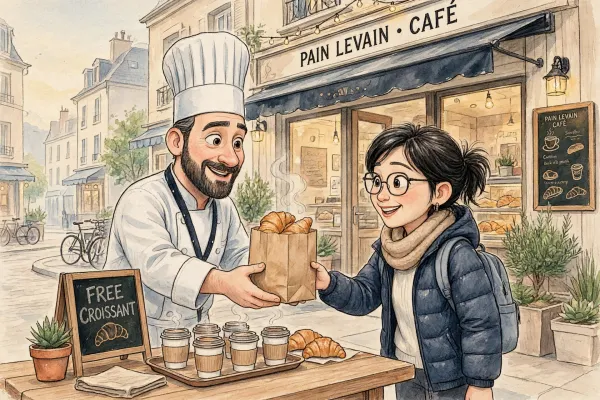
Off the Menu #02 — Life after Croissant
Butter logistics, dessert croissants, a 7 a.m. sidewalk promo — and one of my cooks reads the basement book like it's nothing. That's the part I can't stop thinking about.
Episode 2: The Crescent That Conquered Paris
Chef Daniel's "Caesar 1924" special is the talk of the restaurant. Then the book pulls him to Vienna, 1683 — where the legend he's chasing isn't there.
Off the Menu #01
One week into the Caesar service: applause at table six, Marco vs. the tongs, the 1806 definition that makes the Old Fashioned the original cocktail — and a fresh shaving of parmesan pressed between the pages of Daniel's book.