
Episode 2: The Crescent That Conquered Paris
Chef Daniel's "Caesar 1924" special is the talk of the restaurant. Then the book pulls him to Vienna, 1683 — where the legend he's chasing isn't there.

The special
For two weeks, the board by the door said the same thing:
Caesar, 1924. No anchovies. Eat it with your fingers.
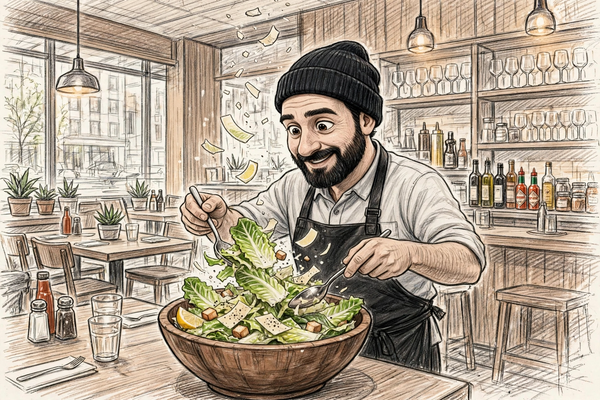
They laughed the first time Chef Daniel told a table to pick up the lettuce with their hands. Then they tasted it — the coddled egg, the lemon, the garlic rubbed straight into the bowl — and the laughing stopped. By the second weekend, people were ordering it before they'd even sat down. A regular named Marc cornered the Chef by the pass and said, "I've had Caesar salad in forty restaurants. Where did you find this recipe?"
Chef Daniel smiled the smile of a man who could never answer honestly. "Old book," he said.
On the last night of the special, after the final plate went out, the dining room did something it had never done: it applauded. Not for him. For a salad invented a hundred years ago by a tired man in Tijuana who understood that dinner could be theater.
Daniel wiped down the pass, locked up, and went down to the basement.
The book was open. It hadn't been open when he left it.
The next page was marked with a crescent, drawn in ink brown with age. Under it, one word: Vienna. Chef Daniel touched the page —
— and the basement tilted.
Vienna, September 1683
Smoke first. Then bells — every church bell in Vienna ringing at once, because the siege was over.
Chef Daniel stood in a street strewn with rubble and celebration. Two months the Ottoman army had camped outside these walls, digging tunnels, starving the city. Now the tunnels were flooded, the camp was abandoned, and the Viennese were pouring into the streets with the particular joy of people who had expected to die and hadn't.
This was the story Daniel knew. Every food writer knew it. A baker, working through the night, hears the Turks tunneling under the bakery. He raises the alarm. The city is saved. And in gratitude — or mockery — the bakers shape their bread like the crescent on the Ottoman flag, so the Viennese can bite their enemy in half every morning.
Chef Daniel went looking for that baker.
He found the bakery district by smell, ducked under a half-collapsed awning, and watched a flour-dusted old man pull a tray from a wood oven. On the tray: crescent-shaped rolls. Golden, familiar — the unmistakable silhouette of the croissant.
"How long have you made those?" Daniel asked, forgetting no one could hear him.
The old man didn't answer, of course. He just kept working, the way men who have made the same thing ten thousand times work — no ceremony, no invention, no eureka. A boy carried the tray to the front of the shop, where a small crowd was already waiting. Morning rolls. Ordinary morning rolls.
And Daniel understood, standing invisible in 1683, that the legend wasn't here. The crescents were already here — old news, breakfast. Nobody in this bakery was inventing anything. The story about the heroic baker and the Ottoman flag would come later, much later, told by people who needed the pastry to have a better origin than "we've always made these."
He felt the floor tilt again — but this time it didn't throw him home. The book wasn't done with him.
Paris, 1839
The smell changed first: from woodsmoke to butter, from rubble to fresh paint.
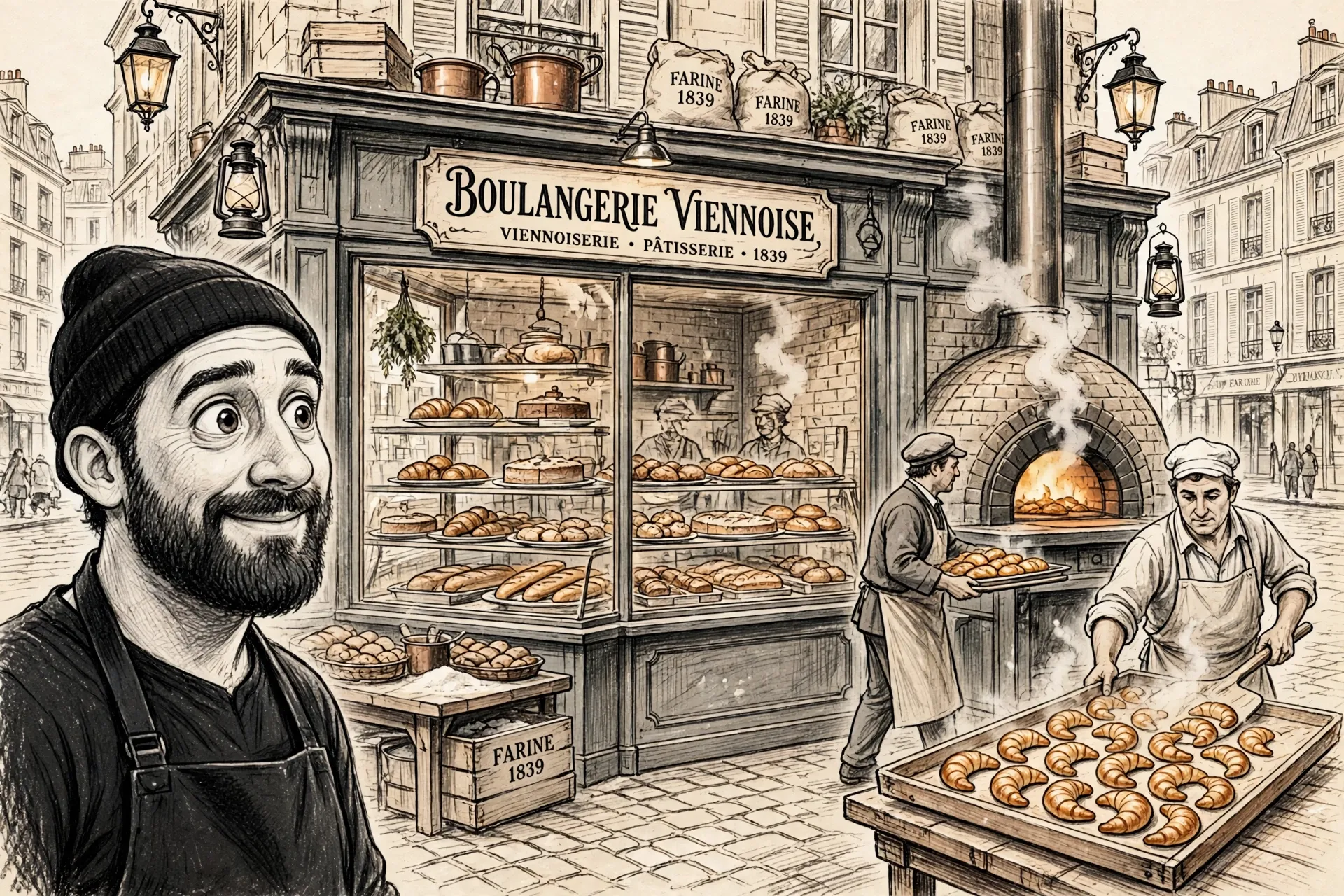
BOULANGERIE VIENNOISE — 92, rue de Richelieu.
Daniel stood across the street from the most talked-about bakery in Paris, and he could see why. The window display was theater — pyramids of golden rolls, crescents arranged like a sunrise, a handwritten sign promising le pain de Vienne. Inside, the shop was packed shoulder to shoulder with Parisians who had never tasted anything like this.
Behind the counter moved a man in his early thirties, all energy and calculation: August Zang. Not a baker by birth — an artillery officer, son of a Vienna surgeon, who had come to Paris with an oven design and a marketing instinct. Daniel watched him work the room the way Cardini had worked his dining room in Tijuana: the product was good, but the performance was the business.
In the back, Daniel saw the real machine: the steam oven, Zang's true invention for France — moist heat that gave every roll a lacquered, chestnut shine. A baker slid a tray of kipferl out of its mouth, and Daniel finally saw one up close in its own century: dense, yeasted, golden — a crescent, yes, but a bread crescent. Chewy, not shattering. Nothing like the thing Parisians would soon call a croissant.
A woman in a silk dress bit into one and closed her eyes. Daniel heard her tell her companion, "It's like nothing we make."
She was right. And within a year, every ambitious baker in Paris would be trying to prove her wrong.
The room shimmered — and when it cleared, the street outside was different. Automobiles. Electric light. Daniel was still on the rue de Richelieu, but the calendar had jumped forward seventy years.
In a bakery basement, a French baker in a white apron was doing something Zang's bakers had never done. He laid a slab of cold butter on a sheet of yeasted dough, folded it like a letter, rolled it out, folded it again. And again. Each fold doubling the layers — butter, dough, butter, dough — until a single bite would contain dozens of whisper-thin strata.
Daniel leaned close. The baker slid the tray into the oven, and the crescents began to rise and separate into leaves, each layer puffing away from the next, turning to glass.
That was the moment. Not the siege. Not the queen. This: a French baker looking at an Austrian roll and thinking, what if it shattered?
The floor tilted one last time —
The record
— and Daniel was on the basement steps, the book closed on his knees, dawn leaking through the small window.
Here's what the documents say about what he just saw.
The crescent roll is old. Written records put the kipferl in Austria back to at least the 13th century — a dense, yeasted, crescent-shaped roll, made in various shapes, eaten for breakfast. It predates the Siege of Vienna by four hundred years.
The 1683 legend — the night-shift baker, the tunneling Turks, the mocking crescent — has no contemporary source. None. An Austrian pastry chef, Jürgen David, puts it plainly: the story is "almost certainly untrue." The kipferl was already there. The legend was invented later to give an old roll a heroic birthday.
The Marie Antoinette story fails the same way. The tale says the Austrian-born queen brought her beloved kipferl to Paris when she married the future Louis XVI. But she died in 1793, and there is not a single French reference to anything called a croissant before roughly 1850 — the food historian Alan Davidson found the earliest mention among the "fancy breads" in Payen's Des substances alimentaires in 1853. As the scholar Jim Chevallier notes, Marie Antoinette got the media coverage of a modern celebrity; if she had started a pastry craze, someone would have written it down.
The paperwork starts with August Zang. Born in Vienna in 1807, son of a surgeon, artillery officer — then, around 1837, he went to Paris and opened the Boulangerie Viennoise at 92, rue de Richelieu (1838 or 1839; the sources differ on the year). He sold Viennese specialties — kipferl, Vienna bread, kaiser rolls — baked in his patented steam oven, which gave everything a lacquered shine and which France would adopt as standard. He advertised in newspapers and staged his window like a theater. It worked: by 1840, Paris already had at least a dozen makers of Viennese bread employing a hundred workers. Zang sold the bakery a few years later, returned to Vienna in 1848, and founded Die Presse — the newspaper that still exists today. His ornate tomb in Vienna's central cemetery says nothing about baking. (And no — despite what some baking histories claim, he did not invent the baguette. No period source supports it.)
But Zang's kipferl still wasn't the croissant. The transformation was French, and it was technical: lamination — folding butter into yeasted dough, again and again, to build dozens of layers. In 1915, a French baker named Sylvain Claudius Goy published the recipe that married the crescent form to laminated dough. That is the croissant we know. Chevallier's line is the cleanest summary ever written on the subject: "The croissant began as the Austrian kipfel, but became French the moment people began to make it with puffed pastry, which is a French innovation."
The French even named the whole category after the borrowing: viennoiserie — literally, "things from Vienna."
The verdict: Austrian shape, French soul. The 1683 siege story is myth. The Marie Antoinette story is myth. The Zang story is paperwork — and the lamination story is the real invention, the one nobody puts on a postcard.
The return
Daniel climbed the stairs at dawn and went straight to the walk-in. Butter — the good French kind, 84% fat, cold enough to snap. Flour, yeast, salt, a little sugar, milk.
He'd laminated dough a thousand times. But that morning, with Vienna and Paris still ringing in his head, he did it the way the book had shown him: the slab, the letter fold, the turn, the rest. Twenty-seven layers. He shaped the crescents the way Zang's bakers had — and then he waited for the oven to do the French part.
By eight, the whole restaurant smelled like 1915. Daniel wrote on the board:
Croissant — Vienna to Paris, 1839–1915. Real butter. Twenty-seven layers.
It would stay for two weeks. The book would decide what came next.
The chef's note
Here's what nobody tells you about a croissant: the crescent is marketing. The layers are the invention.
Twenty-seven layers is the classic count — three folds of three — but the number isn't the point. The point is the war between the butter and the dough. The butter has to be cold enough to stay solid and warm enough to bend. Too cold and it shatters into shards inside the dough. Too warm and it melts in, and you've made brioche, not a croissant. Every layer is a negotiation.
And here's the part that would have surprised Zang: in France today, the shape tells you the recipe. A straight croissant is au beurre — all butter, the real thing. A crescent-shaped one is ordinaire — made with margarine or cheaper fat. The Austrians gave us the crescent; the French kept it for the cheap version and straightened the luxury one. Four hundred years of history, and the shape ended up meaning the opposite of what you'd guess.
Use real butter. Count your folds. And when it shatters all over the table — that's not a mess. That's 1915 happening in your mouth.
That night, Daniel opened the book again. The next page was stuck to the one after it — glued by something brown and savory. He peeled them apart carefully. A grease spot, shaped roughly like a province. Under it, one word: Poutine. The page smelled like a diner at 2 a.m.
Daniel touched the stain —
— and the basement tilted.
Next week: Episode 3 — Poutine.
Never miss an issue
Get the next secret history first
One story a week. No recipes, no spam — just the real history behind what we eat and drink.
Keep reading
Pizza Origin: The True Story (Naples, 1889)
Naples, 1780s: a street vendor, a suspicious tomato, and the birth of pizza. Then 1889 — the queen, the letter, and the forgery that sold a million pies.
Off the Menu #02 — Life after Croissant
Butter logistics, dessert croissants, a 7 a.m. sidewalk promo — and one of my cooks reads the basement book like it's nothing. That's the part I can't stop thinking about.
Off the Menu #01
One week into the Caesar service: applause at table six, Marco vs. the tongs, the 1806 definition that makes the Old Fashioned the original cocktail — and a fresh shaving of parmesan pressed between the pages of Daniel's book.