
Episode 4, Poutine Origin: The True Story of Quebec's Dish
Warwick, 1957: fries, fresh curds, and a curse — but no gravy yet. Drummondville, 1964: the gravy arrives, and the certificate goes on the wall. Who really invented poutine? Nobody. A region did.

The pineapple guy came back.
I don't mean another night — I mean he was still at table four when I walked out with the first Nutella calzone, and he never really left. He ate the whole thing. Then his wife ordered one. Then table six. Then the bar. Fourteen calzones by the end of the night, and the margherita — the dish that had carried the whole week, two hundred pies on Friday alone, basil after the oven, the beautiful monotony of it — got demoted to the side show at its own party.
The pineapple guy ordered a second calzone and told me he'd been wrong about everything. I said I'd get it printed on a t-shirt. I'm not ruling it out.
Saturday. Last pizza night. The oven never really cooled. A regular who'd eaten here every Thursday for a year told me the pizza was "the best thing you've ever done," then immediately asked when it was leaving, like I'd told him his dog was sick. Thursday. It's leaving Thursday.
 KossMass
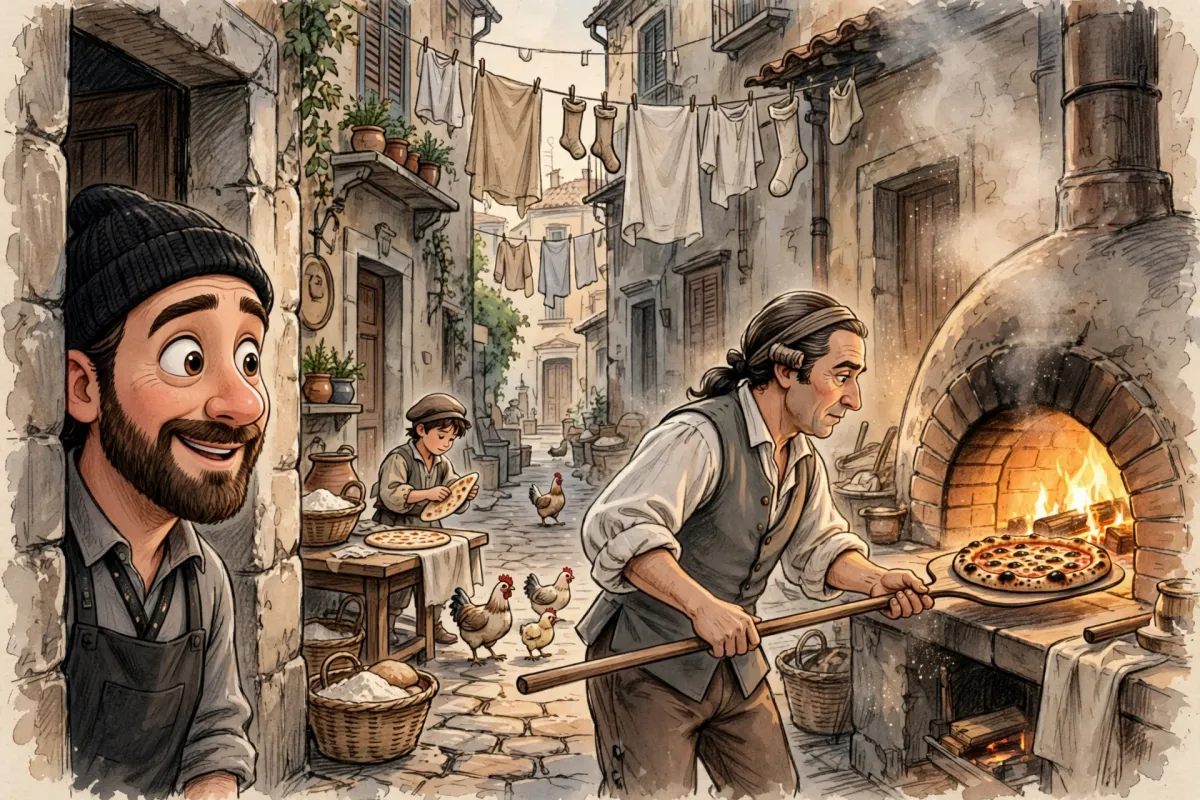
And then there was the smell. Under the woodsmoke, all week, something else had been building in the basement. Rich. Brown. The kind of smell that sticks to a winter coat. I'd been ignoring it the way you ignore a noise in your car. Saturday night, wiping down the pass, I finally followed it downstairs.
Cold air under the basement door. The book wasn't on its shelf behind the water heater. It was on the worktable — where it had been a week ago, when I'd found it open to the snowy street, the hand-painted sign, Canada. Québec. Only now there was a ring on the page. A brown ring, like the bottom of a bowl had sat there. Gravy. Still tacky to the touch. The book had been... eating?
I asked the cook — the one who'd read the book and gotten nothing but recipes out of it — what he'd seen on that page. He shrugged. "Stain looked like gravy, chef." He'd read the basement book and gotten a stain. I'd read it and gotten centuries. I didn't sleep well.
I touched the page. It was still warm.
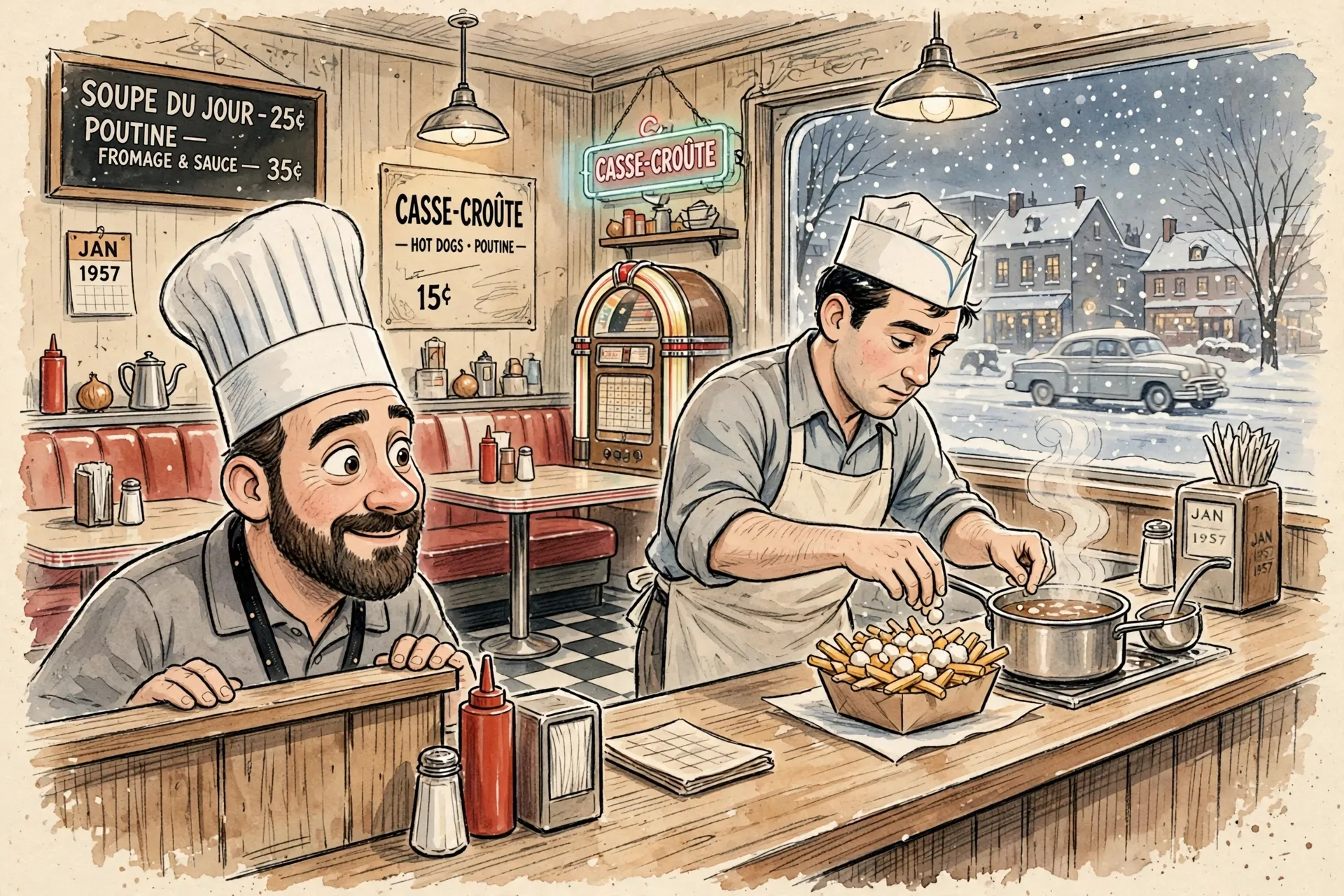
Then I was standing on a roadside in the Centre-du-Québec, and it was 1957, and it was snowing sideways, and a man behind a counter was about to invent something by accident.
Warwick
The place was called the Café Idéal. Later it would be called Le Lutin qui rit — the laughing goblin, which tells you something about Quebec restaurant naming. Small room, linoleum, a fryer that never stopped, and a regular in a work coat who was in a hurry and asked Fernand Lachance to put his fries and his cheese curds in the same paper bag.
Lachance looked at him. Looked at the bag. Said the thing: "Ça va faire une maudite poutine!" — that's going to make a damn mess.
He did it anyway. Fries, fresh curds, one bag. The regular left happy. The name stuck so hard it ended up on the 1957 menu.
I got one. Ate it standing up, snow in my collar. And here's the thing nobody tells you about the famous invention moment: there was no gravy. None. Fries and curds in a bag, and that's the whole legend. It was good — hot fries, squeaky curds, the salt — but it wasn't poutine. It was a bag of ingredients with a great name.
I stood there in 1957 with cheese squeaking between my teeth and thought: the name was born here. The dish wasn't finished.
The book agreed. The page turned itself.
Drummondville
Le Roy Jucep. Drive-in, chrome, carhops — the works. Jean-Paul Roy behind the counter, and Jean-Paul Roy was a sauce man. He'd been selling fries with gravy since 1958, a thing called patate-sauce, and his customers had developed a habit: they'd buy a side of cheese curds and dump them in themselves. In one telling, a regular named Eddy Lainesse started it. In every telling, the customers started it.
Roy watched this happen for years. Then, in 1964, he put it on the menu himself: fromage-patate-sauce. Cheese-potato-gravy. It was accurate and it was terrible, so it got renamed — after Ti-Pout, the cook, and the old slang word for pudding. Poutine.
There was a framed certificate on the wall, from the Canadian Intellectual Property Office, alluding to Roy having invented the thing. I stared at it for a while. A government certificate for a mess in a bowl. Only in Quebec.
I ordered one. Fries, curds, gravy — all three, together, on purpose, sold as one dish. The gravy was hot enough to soften the curds without drowning the fries. The curds squeaked. The fries held.
This was poutine. Not the bag in Warwick. This.
Daniel's rule of kitchens: the customer is always the real recipe developer. Roy just wrote down what the room was already doing.
Princeville
One more stop, because the book wanted me to see it. La Petite Vache, in Princeville. No eureka moment, no famous quote, no certificate on the wall. Just customers, again, mixing cheese curds into their fries until the restaurant gave up and put it on the menu. One version even had gravy. They called it the Mixte — the mixed one.
Three towns. Three versions. And every single one of them starts the same way: not with a chef having an idea, but with a customer making a mess.
That's when I understood what the book was trying to tell me. In Warwick, I'd arrived expecting the invention of poutine and found the invention of a word. The dish itself was assembled slowly, across a whole region, by people who already had fries, already had fresh curds, already had gravy — and one day stopped eating them separately.
Nobody invented poutine. Centre-du-Québec assembled it.
The record
The word. Start here, because the word is older than the dish and weirder than you'd think. The Dictionnaire historique du français québécois lists fifteen meanings of poutine in Quebec and Acadian French — most of them foods — with some senses in use since at least 1810. The "fries with cheese and gravy" meaning is dated to the early 1980s in English. The popular story, repeated by Merriam-Webster, is that it comes from Quebec slang for "mess" — which is exactly what Lachance said he was making. The dictionary's editors think it's more likely inherited from regional French: Provençal poutingo ("bad stew"), Languedocien poutringo ("mixture of various things"). Either way, the dish sense is probably not from the English "pudding" — though the Acadians have their own poutine râpée, a boiled potato dumpling, which is a completely different dish and likely came from German Klöße. Same word, different universe.
Warwick, 1957. Fernand Lachance, the Café Idéal (later Le Lutin qui rit). A regular in a hurry, fries and curds in one paper bag, "ça va faire une maudite poutine!" The dish — fries and curds, no gravy — appears on the 1957 menu. Gravy gets added around 1962, to keep it warm. This is the name's birthplace, documented on a menu. What it is not is the birthplace of the dish as we know it.
Drummondville, 1958–1964. Jean-Paul Roy, Le Roy Jucep. Fries with gravy from 1958; customers adding their own curds; the combination on the menu in 1964 as fromage-patate-sauce, renamed poutine. The framed certificate from the Canadian Intellectual Property Office sits on the wall to this day. Food researcher Sylvain Charlebois — Dalhousie professor, author of Poutine Nation — splits the difference cleanly: Warwick is the birthplace of poutine, but Roy is the true inventor, because Le Roy Jucep was the first to sell all three components as one dish, in 1964.
The customers. Here's the view I like best, and it comes from The Oxford Companion to Cheese: the inventors weren't chefs at all. They were the customers — the ones dumping curds into their fries in Warwick, Drummondville, and Princeville until the restaurants surrendered and menued it. Every origin story in this chapter has the same shape: a customer makes a mess, the cook names it.
The curd. This is the non-negotiable part. Fresh cheddar cheese curds — fromage en grains — less than a day old, kept at room temperature, never refrigerated. They squeak: skouik-skouik between the teeth. The squeak is physics, not poetry — unpressed curds trap tiny air pockets in their protein structure, and the pockets rub against tooth enamel when you bite. After about 24 hours, or one trip through a fridge, the squeak dies, and with it the dish. This is why poutine stayed a country snack of Quebec's dairy region for decades: the curds don't travel. Outside Quebec, people substitute diced low-moisture mozzarella. In Quebec, that is not poutine. I'm from Terrebonne. I don't make the rules. Actually, I do make the rules: no mozzarella.
The gravy. A medium-thin brown gravy — half beef stock, half chicken is the classic ratio — built on a butter-flour roux, black pepper, served hot enough to half-melt the curds but not so thick it congeals on the fries. Some Quebec diners add a splash of cider vinegar. It should soften, not drown. The gravy is the late arrival that made the dish: Warwick's 1957 version didn't have it.
The spread. For decades poutine stayed in the cantines and casse-croûtes, the roadside potato shacks and hockey arenas of Quebec. In 1969 Ashton Leblond's food truck brought it to Quebec City — the business that became the Chez Ashton chain. La Banquise opened in Montreal in May 1968 as an ice cream shop (poutine didn't arrive there until the early 1980s — another legend that needs its dates checked). Burger King put it on the menu in 1983, and the dish's reputation suffered through years of inferior cheese and drunk-food status. Montreal chefs would make it for staff but wouldn't dare menu it. Then, in November 2001, Martin Picard of Au Pied de Cochon served a foie gras poutine, critics lost their minds, and the gates opened: lobster poutine in Toronto, braised beef poutine, the 2010s explosion of poutineries. La Poutine Week runs every February since 2013. International Poutine Day is April 11. In March 2016, poutine was served at a White House state dinner. Sylvain Charlebois again, and he's right: "What poutine has accomplished in 50 years, it took pizza 110 years."
The identity fight. This part matters, so I'll say it straight. Poutine gets called "Canada's national dish," and a lot of Quebecers hear cultural appropriation in that label. Researcher Nicolas Fabien-Ouellet, in his 2016 study "Poutine Dynamics" (published in CuiZine), argues the dish should be labeled explicitly Québécois, not Canadian — and traces how Quebec's youth reclaimed a once-stigmatized working-class food as a badge of identity, a deliberate reversal of the insult. Writer and critic Lesley Chesterman puts it more bluntly: "It's more interesting to say that a dish is Quebecois than to say that it is Canadian." The dish went from shame to pride in one generation. That's not a food story. That's a people story.
Verdict: Nobody invented poutine. A region assembled it — Warwick gave it a name in 1957, Drummondville gave it its final form in 1964, and the customers did the inventing in between. The curds must squeak, the gravy must be hot, and the whole thing belongs to Quebec.
I came back with gravy on my sleeve and snow in my hair that wasn't from this century. Upstairs, the dining room was mid-prep, oblivious. I didn't waste a minute. "Russets — cut them now, medium-thick, they're getting double-fried. Gravy on: butter, flour, half beef stock, half chicken, keep it thin." Marco was already reaching for the phone before I said his name. "Call the suppliers. Fresh curds — today's, not yesterday's. They squeak or we don't serve it."
Then I took the chalk, wiped "PIZZA, 1889" off the board — the ghost of it still there if you looked — and wrote:
POUTINE, 1957(?)
The question mark is doing a lot of work. Some legends you serve with a wink. This one you serve with a footnote.
Chef's note — Daniel's working version
The curd is the dish. Everything else is negotiable; the curd is not. Fresh cheddar curds, made today, kept at room temperature, never refrigerated. Do the squeak test before service: bite one. If it doesn't go skouik-skouik, it's garnish, not poutine. If your supplier can't get you same-day curds, you don't serve poutine that day. I'd rather 86 it than fake it.
Fries: russets, cut medium-thick, double-fried. First fry at 325°F until soft and pale — you're cooking the interior. Rest them. Second fry at 375°F until golden — that's the crust. Salt immediately. The fry has one job: survive the gravy for five minutes without going limp.
Gravy: half beef stock, half chicken stock, butter-flour roux, black pepper, and keep it thin — thinner than you think. It should coat, not blanket. It goes on last, it goes on hot, and it goes on at the pass, never in advance. The heat half-melts the curds. That's the whole trick. If your gravy is thick enough to stand a spoon in, you've made stew.
Assembly, in order, no debate: fries, curds scattered, gravy poured over. Serve immediately. Poutine has a five-minute window. After that it's archaeology.
And no mozzarella. Ever. I don't care what they do across the border with their "disco fries." Here, the curd squeaks or the dish doesn't exist.
Quick facts
- Origin: Centre-du-Québec, late 1950s — Warwick named it (1957, on the menu), Drummondville completed it (1964, all three components).
- Key ingredients: double-fried russet potatoes, fresh cheddar cheese curds (same-day, room temp), hot brown gravy.
- Defining technique: gravy poured over at the pass, hot enough to half-melt the curds without killing the fry crunch — a five-minute serving window.
- Surprising details: the squeak is air pockets in unpressed curd protein rubbing your tooth enamel — it dies after ~24 hours or one night in the fridge; and poutine was served at a White House state dinner in March 2016.
The board says POUTINE, 1957(?). The fryer is already heating — first fry at 325, and the whole kitchen smells like a casse-croûte in the best way. Tomorrow someone will burn their tongue on the gravy and say it's worth it, and they'll be right.
But tonight, wiping down the pass, I caught something else under the fryer oil. Sour. Alive. Cabbage and chili and garlic, fermenting in a jar in the dark somewhere, breathing.
The next page is already turning.
Never miss an issue
Get the next secret history first
One story a week. No recipes, no spam — just the real history behind what we eat and drink.
Keep reading
Off the Menu #07 — Watched
Carbonara week: a cook reaches for the cream, the eggs keep scrambling — and late one night, Daniel finds two people at the basement window, faces to the glass. A third is watching from the alley.
Episode 7 — Carbonara Origin: The True Story (Rome, 1939)
Carbonara was on a Roman menu in 1939 — five years before the American rations it's blamed on. The charcoal myth, the general's dinner, the gruyère scandal, and the rules that arrived last.
Off the Menu #06 — Table Twelve
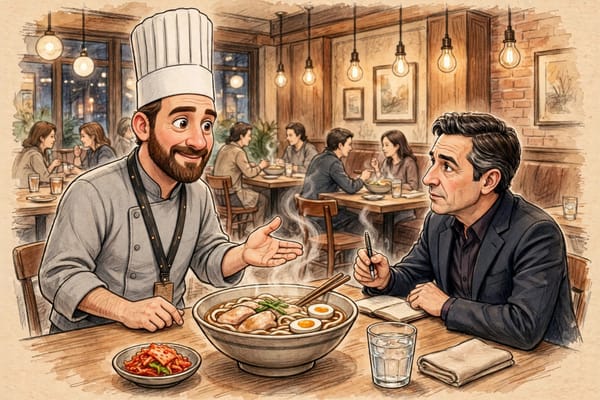
Kimchi week brings a new chicken udon, a full dining room — and a food critic at table twelve who finishes the whole bowl. Later, the book's amber-ringed page gains a garnish.