
Off the Menu #07 — Watched
Carbonara week: a cook reaches for the cream, the eggs keep scrambling — and late one night, Daniel finds two people at the basement window, faces to the glass. A third is watching from the alley.

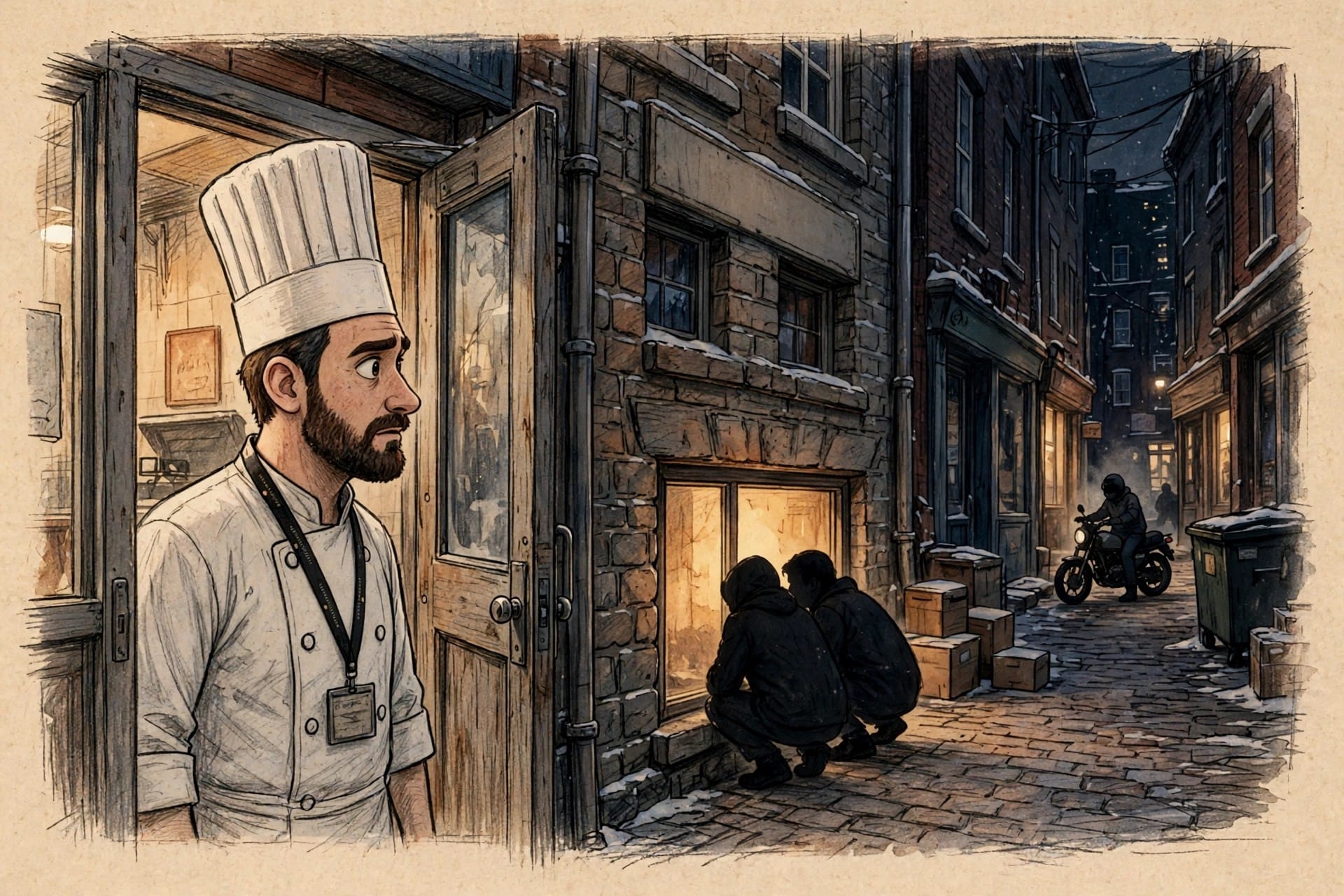
Carbonara week at Salt and Myth, and the board by the door says CARBONARA, 1939(?) — the question mark earning its keep, as always. The dish goes out one way and one way only: guanciale rendered slow, yolks and Pecorino Romano worked into a paste, the pasta dragged through off the heat, pepper like it means it. No shortcuts. No exceptions.
Which is how, on the second night, our newest cook ended up holding a carton of cream over a pan, looking at me the way you look at a man you're about to disappoint.
"It would make it easier, chef. More stable. A little cream, the sauce never breaks—"
"No."
"It was just an idea—"
"It's a good idea for a different dish." I took the carton out of his hand and put it back in the walk-in myself. "Cream has been in carbonara before — it's in the old printed recipes, I've read them. History is allowed. My kitchen does it the way the menu says. The menu says never."
He nodded like a man memorizing a fence. Fair enough. You don't learn the rule until you've reached for the thing it forbids.
The cream was the easy problem. The eggs were the war.
All week, from the pass, I could hear it before I could see it: a pan left on the heat ten seconds too long, and the sauce that should have poured like gloss came up scrambled — little cooked curds clinging to the spaghetti, breakfast wearing a Roman costume. Twice on Thursday we refired plates. Marco said nothing and learned fast, the way he does. The others were fighting the pan, wrestling it, and the pan was winning.
So on Friday, before service, I called them to the stove and made one plate, slowly, out loud.
"Cold pan. Guanciale in. Low heat — you're rendering, not frying." The fat ran clear gold. "Off to the side, yolks and pecorino, a paste like wet mortar. Loosen it with hot pasta water until it pours." I dragged the spaghetti into the pan, off the heat entirely, and tossed — hard, constant, the pan moving more than the flame ever had. "The heat you need is already in the pasta. The pan's job is finished. Your job is to keep moving until it shines."
It shone. One by one they did it after me — the new cook last, hands shaking a little, tossing like the pan owed him money — and his came up glossy, pepper-flecked, perfect. The kitchen made the noise kitchens make. Somebody applauded with a pair of tongs, which Marco pretended not to hear.
FOOD FACT
Carrots weren't always orange. For most of their history they were purple, yellow, or white — the orange carrot is a Dutch creation, selected and bred by growers in the Netherlands in the 1600s and 1700s until the colour held. The popular story says they did it to honor the Dutch House of Orange; historians treat the patriotism as a garnish on the facts, but the breeding itself is documented. So the most ordinary vegetable in the crisper is a few centuries of marketing wearing a root.
THE CLUE
Saturday, after close, I locked up later than usual — receipts, a delivery note, the small paperwork of a week that had gone well. I went out the back, into the alley, the way I always do.
Halfway to the street I stopped. I don't know why. The feeling you get in a kitchen when a burner is on somewhere it shouldn't be.
The basement has one window, low, at alley level, half-frosted and usually lit from below by the pilot glow of the old water heater. There were two people at it. Crouched down, close together, faces an inch from the glass, looking in. Not moving. Looking the way you look at something you've been told about and finally found.
I stood very still. One of them shifted — a hand came up, not to knock. To point. At the corner of the basement where the worktable stands. Where the book was.
I went back inside.
I didn't call out. I went down the stairs, switched on the basement lights — all of them, the bright ones nobody eats under — and looked up at the window from inside. Glass, frost, alley dark. Nobody there. Nobody had been there, if you only had the window to go by.
The book was on the worktable, open to the amber page. The ring on it had gone dark again in the night air, and the one word showing through the paper was still not readable, and suddenly I didn't want to read it down there. Not that night.
I closed the book, tucked it under my arm, and took it home with me. First time it has ever left the restaurant. It rode in the passenger seat like a passenger. I did not feel ridiculous about that until I was home, in my own kitchen, with it on my counter — and then I only felt it a little.
What I didn't see, locking up the second time: at the far end of the alley, engine off, lights off, a third person, sitting on a motorbike.
Watching.
 KossMass
Never miss an issue
Get the next secret history first
One story a week. No recipes, no spam — just the real history behind what we eat and drink.
Keep reading
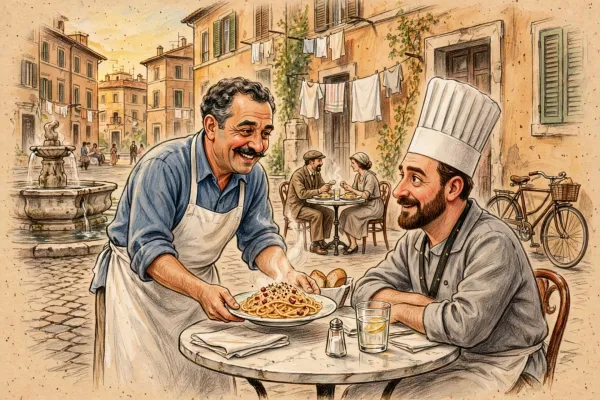
Episode 7 — Carbonara Origin: The True Story (Rome, 1939)
Carbonara was on a Roman menu in 1939 — five years before the American rations it's blamed on. The charcoal myth, the general's dinner, the gruyère scandal, and the rules that arrived last.
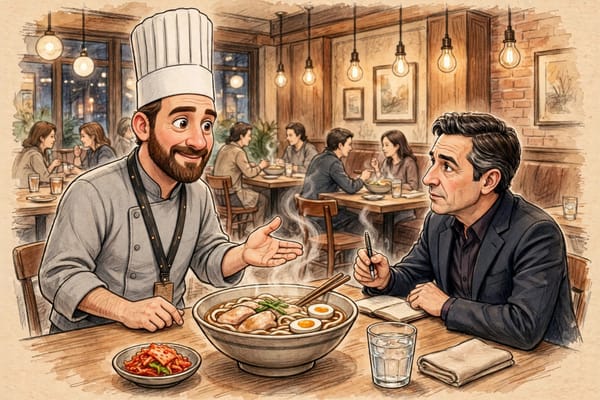
Off the Menu #06 — Table Twelve
Kimchi week brings a new chicken udon, a full dining room — and a food critic at table twelve who finishes the whole bowl. Later, the book's amber-ringed page gains a garnish.
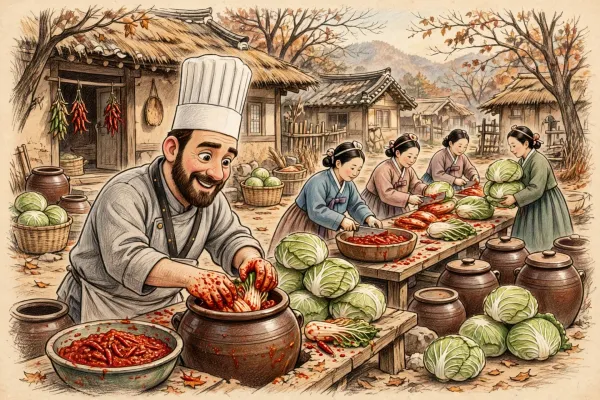
Episode 6: Kimchi Origin — The True Story Behind the Ferment
Kimchi's jar is 2,000 years old. Its fire is 200. Its cabbage is younger than the Eiffel Tower. The true story of Korea's ferment — and the myths it outlived.