
Off the Menu #06 — Table Twelve
Kimchi week brings a new chicken udon, a full dining room — and a food critic at table twelve who finishes the whole bowl. Later, the book's amber-ringed page gains a garnish.

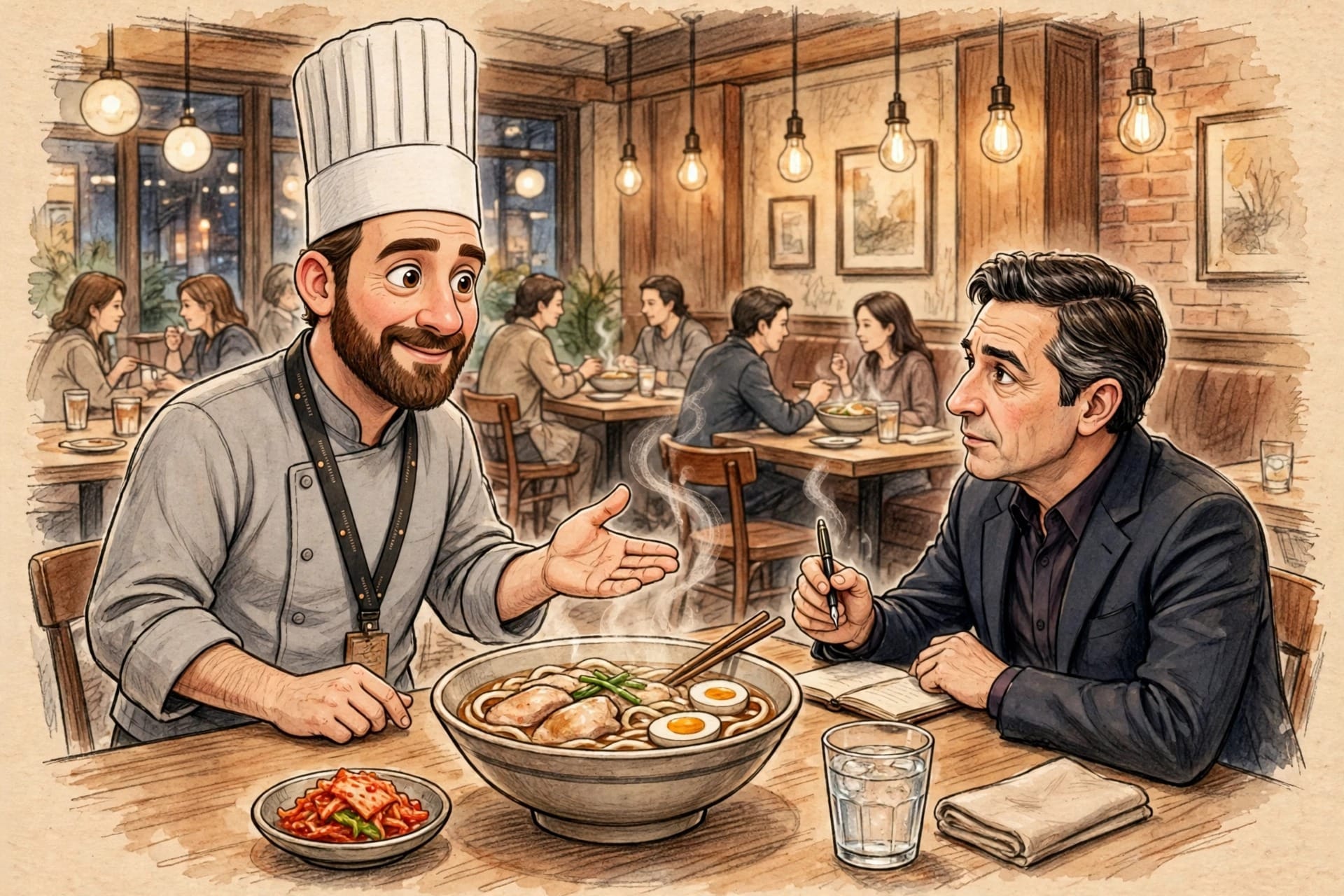
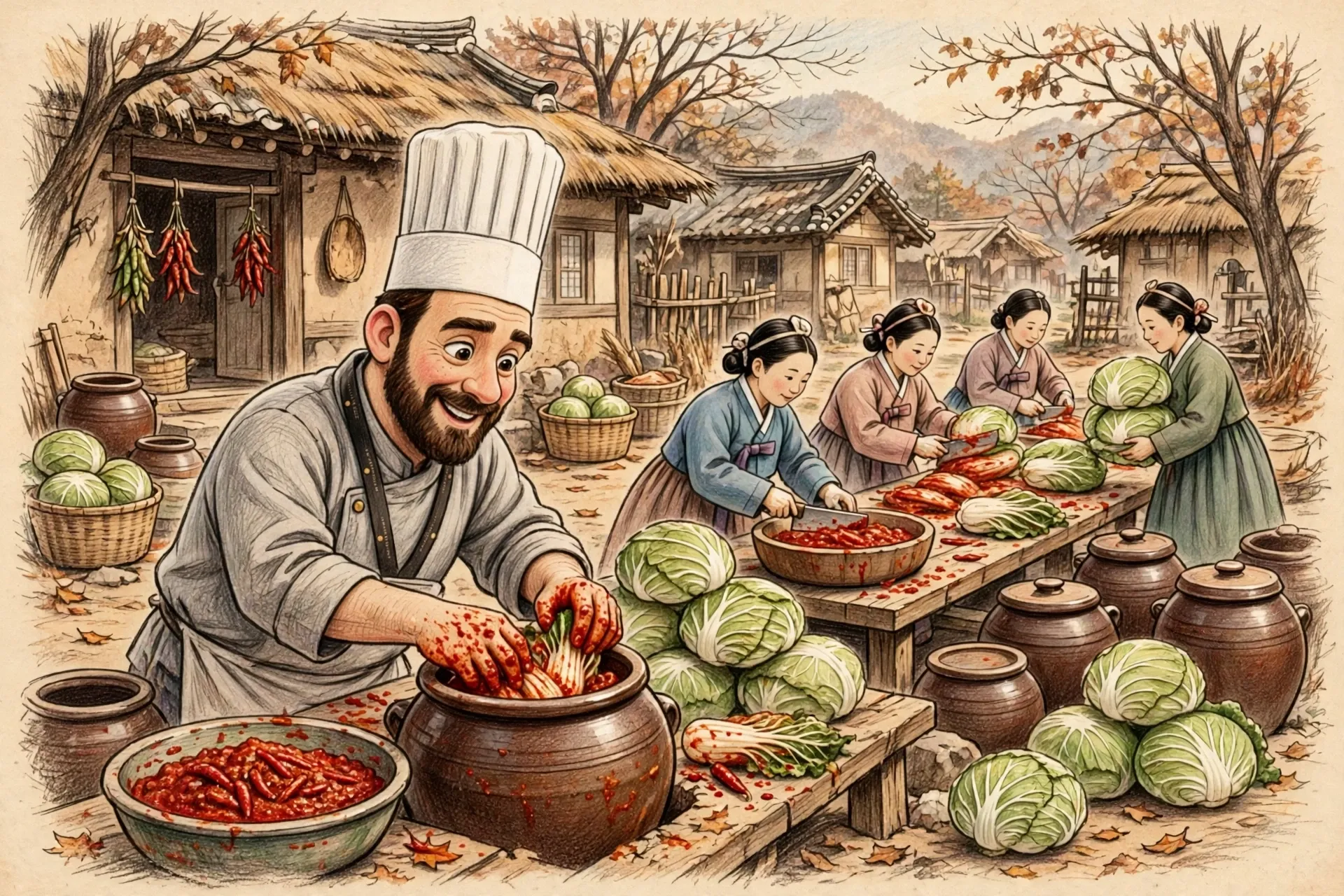
Kimchi week at Salt and Myth, and the board by the door says KIMCHI, 1200s(?) — the question mark now covering eight centuries of white kimchi and one very red one. The jars we packed are open, alive, and selling. Half the dining room orders it as a side. The other half orders it because the first half did.
The new bowl is the chicken udon. Thick noodles in a clear, deep broth, chicken poached in the broth itself so it stays silky, ginger, scallion, a soft egg if you want it — and a spoon of kimchi on the side, not in it. In it is fusion. Beside it is a conversation. People are having the conversation all week: one bite plain, one bite with the kimchi's bite, back and forth until the bowl is gone.
Tuesday, Marco came into the kitchen holding a ticket like it was a live wire.
"Table twelve," he said. "That's him."
"Him who?"
"The critic. From the local newspaper. My cousin showed me his picture last month — it is him."
The whole kitchen went a half-step quieter, the way kitchens do. Cooks suddenly remembered every plate they had ever sent. I looked at the ticket. Table twelve had ordered like a man doing research: the kimchi first, alone. Then the chicken udon. No substitutions. No theatrics.
"Then we cook," I said. "Same as every table. Fire the udon."
His kimchi went out plain, in a small cold dish, nothing hiding behind anything. He ate it slowly, the server said. Wrote two lines in a notebook. Drank water. Waited.
The udon went out steaming, egg trembling on top. From the pass I watched him do what I would have done: broth first, alone, eyes up, thinking. Then noodles. Then a piece of chicken. Then — and this is when I knew we had him — he reached for the kimchi, put a small ribbon of it on the spoon with the broth, and sat very still for a moment.
He finished the bowl. All of it. Critics are professional leavers of last bites, and there was nothing left in that bowl but the spoon's memory.
At the door, on his way out, he stopped. Critics don't do this — they evaporate, that's the whole job — but he stopped, and he found me at the pass, and he said:
"The kimchi is the real thing. And whoever taught you to keep it out of the broth understands both dishes." He put on his coat. "I'll be writing about this place."
Then he was gone, into the Terrebonne night, and the kitchen did the thing kitchens do when the mountain moves past without burying anyone: we exhaled, all at once, and Marco started laughing, and somebody — I won't say who — did a small dance by the dish pit.
FOOD FACT
The word restaurant started as a soup. It comes from the French restaurer — to restore — and in the 1700s a restaurant wasn't a place, it was a thing: a restorative broth of meat and egg, sold as a tonic for weak stomachs. The first Paris shop built around them opened in 1765 or 1766 — the owner's name is recorded as Mathurin Roze de Chantoiseau, sometimes as Boulanger — serving its "restaurants" to seated customers who ordered from a menu, which was the novelty. Within a generation, the broth's name belonged to the building. So the local critic who reviewed us this week was, etymologically, judging a bowl of medicine.
THE CLUE
After close, I went down to change out of my jacket and check on the jars.
The book was on the worktable. Still open past the red page, to the one with the faint amber ring — the ghost of a glass, set down by someone in no hurry. The page that smells of orange peel and burnt sugar and rye.
The ring had company now.
Lying across the bottom of the page, neat as a garnish, was a strip of orange peel. Fresh. The oils still bright when I lifted it — it perfumed the whole basement for a second, citrus over ferment.
Peel doesn't keep. Whoever left it, left it recently.
I didn't put it there either.
 KossMass
Never miss an issue
Get the next secret history first
One story a week. No recipes, no spam — just the real history behind what we eat and drink.
Keep reading
Off the Menu #07 — Watched
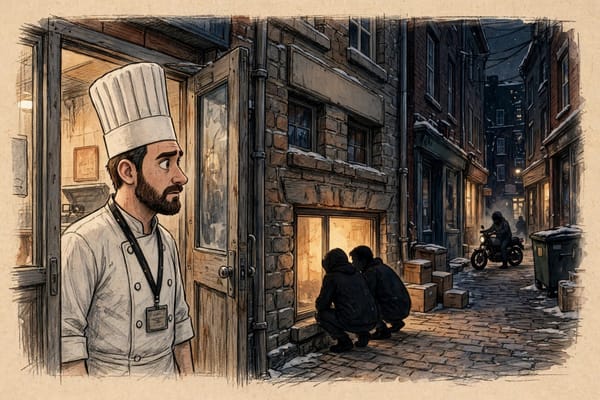
Carbonara week: a cook reaches for the cream, the eggs keep scrambling — and late one night, Daniel finds two people at the basement window, faces to the glass. A third is watching from the alley.
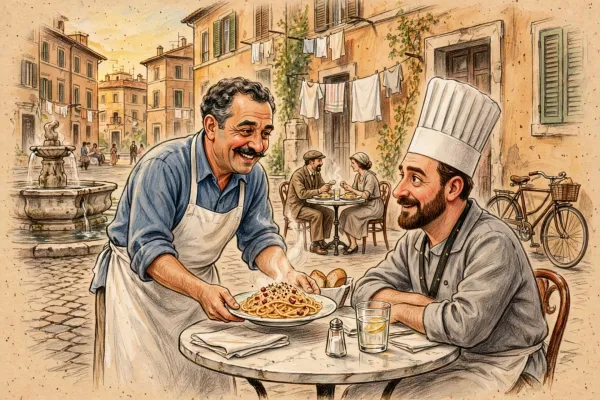
Episode 7 — Carbonara Origin: The True Story (Rome, 1939)
Carbonara was on a Roman menu in 1939 — five years before the American rations it's blamed on. The charcoal myth, the general's dinner, the gruyère scandal, and the rules that arrived last.
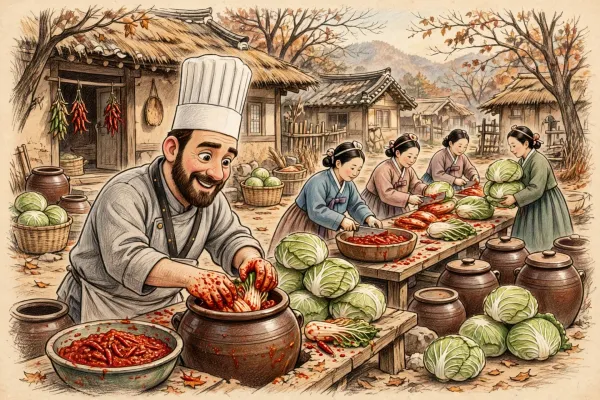
Episode 6: Kimchi Origin — The True Story Behind the Ferment
Kimchi's jar is 2,000 years old. Its fire is 200. Its cabbage is younger than the Eiffel Tower. The true story of Korea's ferment — and the myths it outlived.