Episode 5: Turkey Origin — The True Story (Mexico to Thanksgiving)
A Mexican bird with a Turkish name, an Indian alias, and a holiday it may not have attended. The real history of the turkey — from Aztec ritual to Thanksgiving.

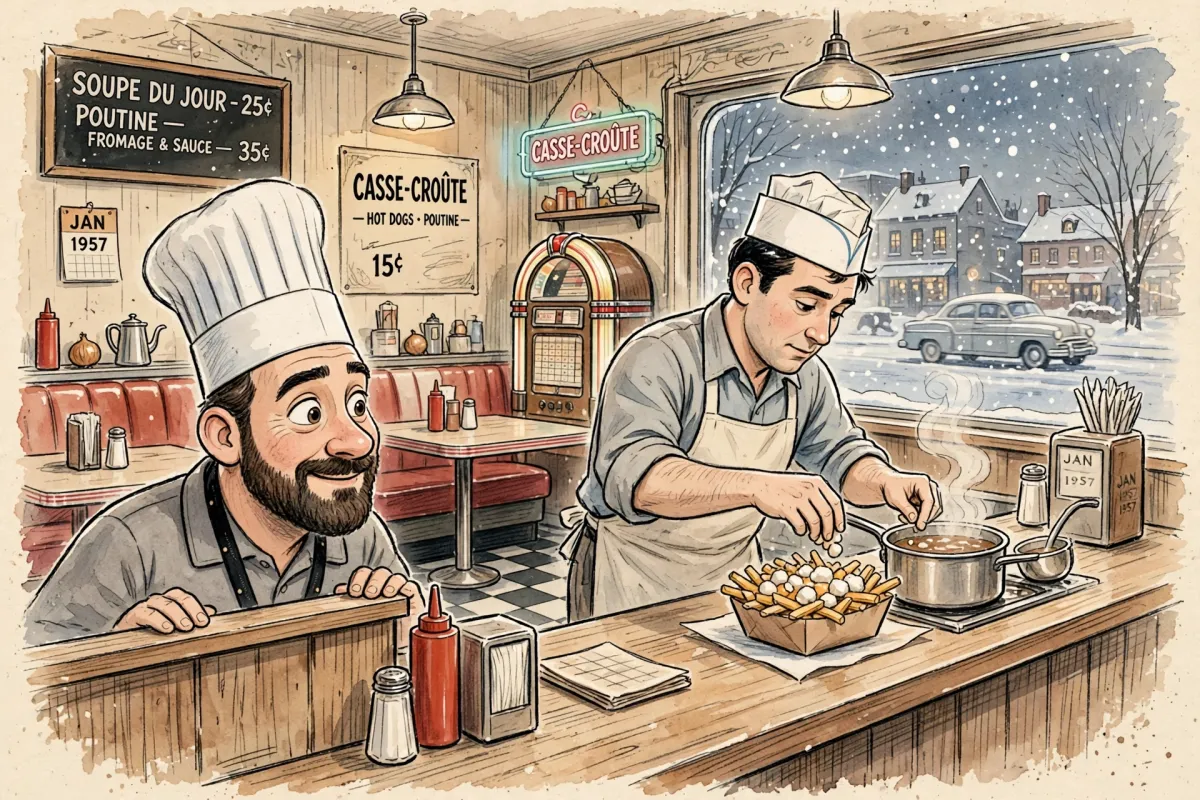
Poutine week was supposed to be over. The board by the door still said POUTINE, 1957(?) — the question mark doing a lot of work — and the dining room still smelled like a casse-croûte in the best way. The fryer hadn't really stopped. It had just slowed down, the way a kitchen slows down when it's tired but not done.
 KossMass
The pineapple guy came in for his fourth week in a row. He ordered the poutine, ate it in respectful silence, and asked — carefully, like a man who'd learned — whether the gravy recipe was a secret. "Everything here is a secret," I told him. "That's the whole restaurant." He nodded like I'd said something profound. I think we're friends now. I'm still not sure how I feel about that.
After close I went down to check the curd delivery for tomorrow. The book was still on the worktable. Still open to the bird — tail fanned wide, drawn in ink. Still one word underneath.
Dinde.
The jar in the basement could wait. The book had already turned past it — past the cabbage and the chili and the garlic — to this page. I poured a glass of 12-year-old whiskey and touched the ink bird. It was still warm.
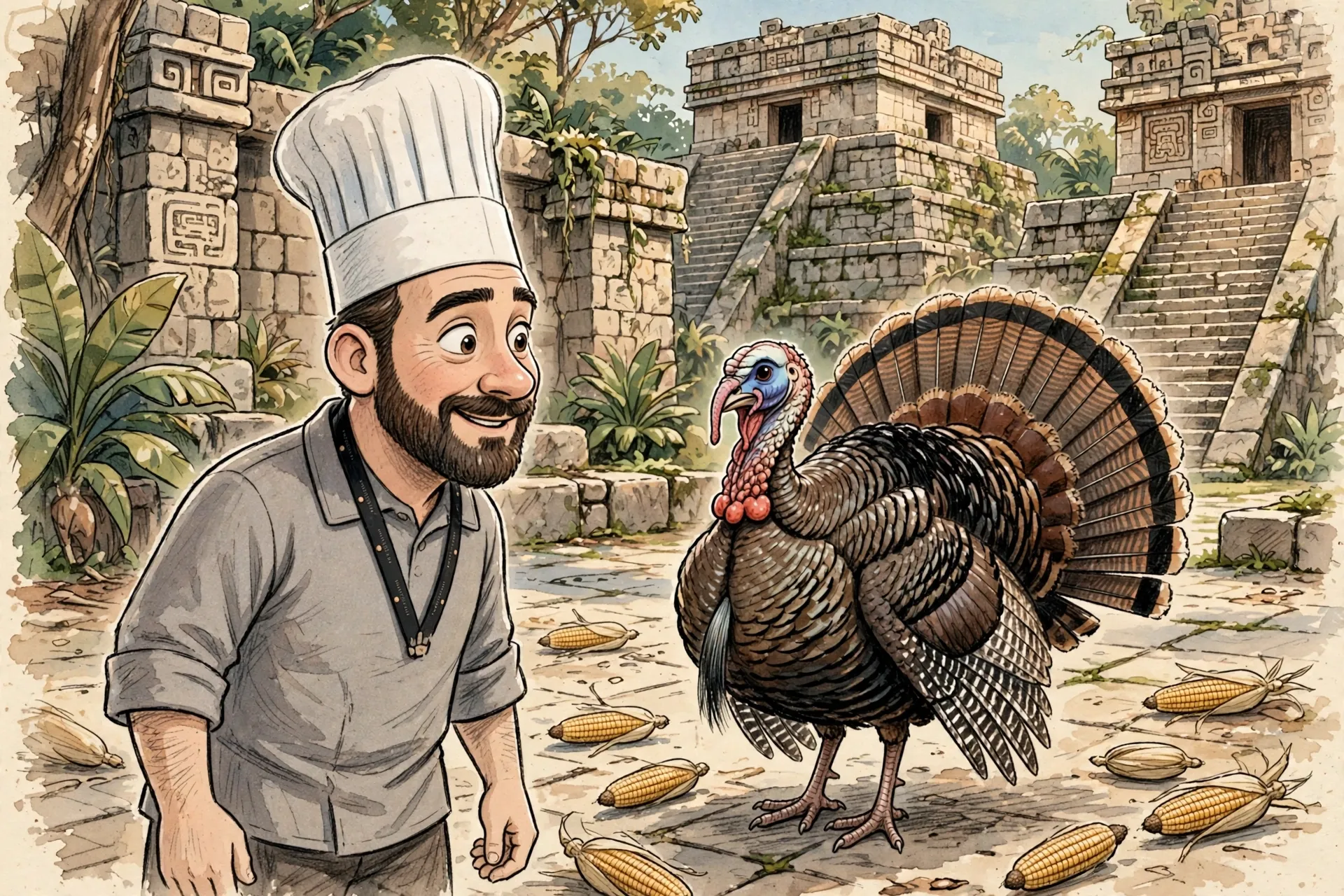
Then I was standing in a courtyard made of stone, and it was hot, and a flock of turkeys was watching me like I was the strange one.
The courtyard
The birds were everywhere. Not in a pen — loose, strutting, fanning their tails at nothing. A keeper scattered maize for them, and they came running, gobbling, shoving. I reached for one the way a chef reaches for dinner, and the keeper grabbed my wrist.
Not food, he told me. Not yet. Feathers. The feathers went into cloaks and headdresses and ceremony. The birds went into temples — some of them buried with the dead, companions for the afterlife. You don't eat the bird that carries your prayers.
I stood there with my chef's hands empty and thought: this is the animal that feeds forty-six million American tables in a single weekend, and here it is, sacred. Untouchable. The meat comes later — centuries later, when the birds become food around 1100 AD. Right now, in this courtyard, the turkey is a ritual, not a roast.
The book agreed. The page turned itself.
The market
Seville, Spain, around 1520. Crates, salt air, men shouting prices. A merchant had a cage of big birds — bigger than any chicken I'd ever seen — and he was calling them turkey-cocks. I asked him where they were from. The Indies, he said. I asked him why they were called Turkish, then. He shrugged the way merchants have shrugged since the beginning of trade. The name came with the other bird.
That's when I understood. There was already a bird called a turkey in England — the guinea fowl, an African bird that arrived in Europe through Ottoman trade routes, through Turkish hands. When this new American bird showed up, bigger and stranger, people did what people always do with a new thing: they gave it an old name. They called it a turkey because the other turkey came from Turkey, and this one came on the same ships, through the same merchants, into the same markets. The name was a shipping error that never got corrected.
Thirty years later — London, 1550 — I watched a man get a coat of arms with a turkey on it — a navigator named Strickland, who'd brought the birds to England and got a bird on his shield for the trouble. A generation after that, Shakespeare was making jokes about turkeys on stage, and the audience didn't need the joke explained. The wrong name had already won. It had won so completely that a Swedish scientist, two centuries later, would give the American bird the Latin name Meleagris — the ancient Greek word for the guinea fowl. The mistake is baked into the science itself.
The book agreed. The page turned itself.
Plymouth
Cold. Grey water, grey sky, a settlement holding on by its fingernails. I'd arrived expecting the famous feast — the one in every school play, the one on every November table. I was ready to see the turkey in the place of honor.
It wasn't there.
The table had venison. It had ducks and geese — the fowl the governor's men had shot, the migrating waterfowl, the efficient hunt. It had eels and corn and whatever else the harvest had given them. But the bird I'd come to find was not on the table. It was in the woods, with the rest of the season's abundance — wild turkeys, everywhere, and nobody had thought to make one the centerpiece. The man who'd write about it later would write about the season, not the feast. The feast's own letter would say only "fowl."
I stood in Plymouth in 1621 and understood: the most famous turkey dinner in history may never have had a turkey. The bird became the symbol of the feast two centuries after the feast, when a magazine editor decided it should be.
The book agreed. The page turned itself.
The magazine
A parlor in New England, 1860s. A Thanksgiving table, and there it was — the turkey, roasted, in the place of honor, big enough to feed the whole room. On the sideboard, a copy of Godey's Lady's Book, open to a story about a New England Thanksgiving with the roasted turkey in the place of honor. The editor, Sarah Josepha Hale, had been writing about this dinner for decades — in her novel, in her magazine, in letters to five presidents — until the country agreed with her. She didn't invent the holiday. She invented the menu.
On the wall, a broadsheet: Lincoln's proclamation, October 1863, declaring the last Thursday of November a national day of Thanksgiving. I read it twice. The word "turkey" isn't in it. Lincoln gave the country the holiday. Hale gave it the bird.
The book agreed. The page turned itself.
The lawn
Washington, 1989. A White House lawn, a crowd, a turkey on a table, and a president reading from a script: the bird "will not end up on anyone's dinner table... He's granted a presidential pardon as of right now."
I stood on that lawn and did the math. Truman — the man the pardon is named after in every school lesson — ate his turkeys. Every one. The Truman Library checked: no pardon, no ceremony, nothing. Kennedy spared a bird in 1963 and never said the word — the newspapers called it a pardon for him. Reagan said the word in 1987, as a joke to dodge questions about Iran-Contra. The first real pardon, the ceremony itself, happened here, in 1989. The tradition is younger than the microwave oven.
The book agreed. The page turned itself.
The record
Domestication. The turkey is one of only two birds native to North America that humans ever domesticated — the other is the Muscovy duck. And it happened twice. Genetic analysis of 149 turkey bones and 29 fossilized droppings from 38 archaeological sites (Speller et al., 2010, Proceedings of the National Academy of Sciences) shows two domestication centers: one in south-central Mexico, one in the American Southwest. The Southwest lineage left no descendants. Every domestic turkey alive today descends from the Mexican line. The earliest captive-reared Mexican turkeys outside their natural range appear at El Mirador, Guatemala (Thornton et al., 2012, PLOS ONE) — the Maya region's native bird is the ocellated turkey, so Meleagris gallopavo bones there mean someone carried them in. And for a long time, the birds weren't food: isotope analysis of 55 Mesoamerican turkeys (Manin et al., 2018, Royal Society Open Science) shows them increasingly maize-fed as husbandry intensified — but most of the studied birds had never been eaten. Some were buried in temples and graves. The turkey started as a sacred animal. Dinner came later.
The name. The English word "turkey" originally meant the guinea fowl — an African bird that reached Europe through Ottoman trade. When the American bird arrived, English speakers transferred the name. The Oxford English Dictionary puts it plainly: after the two birds were distinguished, "turkey was erroneously retained for the American bird, instead of the African." Every language made the same mistake in a different direction: French dinde (short for poule d'Inde, "chicken from India"), Turkish hindi ("Indian"), Russian indyushka ("bird of India"), Norwegian kalkun (after Calicut, in India). The one arguably sensible name is Portuguese peru — at least the bird is American. The Aztecs, who actually lived with the bird, called the god Chalchiuhtotolin the "Jade Turkey" — god of disease and plague, the animal form of Tezcatlipoca. The bird that became a joke about sleepiness was once a god.
Thanksgiving. The two primary sources for 1621 are Edward Winslow's letter (December 11, 1621, published in Mourt's Relation, 1622) and William Bradford's Of Plymouth Plantation (written 1630–51). Winslow, the only contemporary account of the feast, says only "fowl" — never "turkey." Bradford writes that "there was great store of wild turkeys, of which they took many" — but that passage is about the season's abundance, not the three-day feast, which he never mentions. Archaeologist James Deetz argued turkey at the feast was "less than likely, though not impossible" — the migrating waterfowl were the efficient hunt. Historian Jeremy Dupertuis Bangs disagrees. The honest verdict: plausible, not proven. What is proven is how turkey became the centerpiece: Sarah Josepha Hale's 1827 novel Northwood put "the roasted turkey" in the place of honor, and her magazine Godey's Lady's Book spent decades cementing it, until Lincoln's 1863 proclamation made Thanksgiving national — without ever mentioning the bird. Turkey won because it was big enough to feed a crowd, native and abundant, and — unlike a chicken — not a daily egg producer. It was the bird you saved for the occasion.
Franklin. He never proposed the turkey as the national bird. The turkey was never a candidate, and there was no vote. The myth comes from a private letter Franklin wrote to his daughter Sarah Bache on January 26, 1784, from France — about the Society of the Cincinnati, a hereditary officers' society whose emblem was a bald eagle. Franklin thought the emblem looked more like a turkey, and wrote that the eagle "is a Bird of bad moral Character. He does not get his Living honestly" — he steals fish from the fishing hawk — while "the Turkey is in Comparison a much more respectable Bird, and withal a true original Native of America... a Bird of Courage, and would not hesitate to attack a Grenadier of the British Guards." It was a joke about a club emblem, in a private letter. The national bird was never in play.
Tryptophan. The sleepiness is a myth. Turkey contains tryptophan — but so does everything else, and turkey has less of it than chicken or cheese. Per USDA-based comparisons, a cup of roasted chicken breast has about 507 mg of tryptophan; a cup of roasted turkey breast has about 318 mg. Cheddar and parmesan have more per gram than turkey. A sleep-aid dose of tryptophan is 4–5 grams — you'd need to eat roughly ten servings of turkey to get there, and a high-protein meal actually dilutes tryptophan's effect on the brain, since it competes with other amino acids. The real culprits after Thanksgiving dinner: the sheer size of the meal, the high-glycemic carbs (stuffing, potatoes, pie), and the alcohol. The turkey is innocent. (Sources: McGill Office for Science and Society; USDA nutrient data.)
The pardon. The timeline, documented: Lincoln's son Tad befriended the family's 1863 Christmas turkey and Lincoln spared it — a pet story, not a ceremony. Truman received the first National Turkey Federation bird in 1947 and ate it; the Truman Library found no record of any pardon. Kennedy spared a 55-pound bird in 1963 ("We'll just let this one grow") — the press supplied the word "pardon." Reagan first said "pardon" in 1987, as a joke deflecting Iran-Contra questions. George H. W. Bush performed the first formal pardon in 1989. Every president since has done the ceremony. The tradition is 37 years old.
Wild vs. domestic. The wild turkey nearly vanished: from an estimated 10 million birds before colonization to roughly 200,000 by the early 1900s — hunted hard, its forests cut down, extinct in 18 states. It came back through the Pittman-Robertson Act (1937), which taxed hunting gear to fund wildlife management; through 1950s cannon-netting that captured wild birds alive for relocation; and through interstate trades — states swapped turkeys for walleye, prairie chickens, mountain goats, moose, otters, fishers. The National Wild Turkey Federation, founded 1973, has put over $500 million into the work. Today there are roughly 6–7 million wild turkeys in 49 states. The wild bird flies in short bursts up to 55 mph, roosts in trees, and sees 270 degrees around itself. Its domestic cousin, the Broad Breasted White — dominant since the 1960s, bred for massive breast meat, averaging 38–40 pounds — cannot fly, and cannot mate naturally. The breed is maintained entirely by artificial insemination. Without human intervention, it would vanish in one generation. And the old story that turkeys drown staring up at the rain? No documented case. Some turkeys have a rare neurological spasm that makes them stare skyward for seconds — and young poults can die of exposure in storms — but no turkey has ever drowned watching the sky.
Verdict: The turkey is a Mexican bird with a Turkish name, an Indian alias in half of Europe, and an American holiday it may not have attended. It started as a god, became a shipping error, and ended up as dinner — and every part of that story is wrong in the telling except the bird itself.
I came back with dust on my shoes that wasn't from this century. It was already late at night — the dining room dark, the kitchen closed, nobody left to tell. The whiskey was still on the worktable where I'd left it. I drank the last sip, went up, took a shower, and went to bed.
The next day I started preparing the Thanksgiving menu of the week. I didn't waste a minute. "Turkeys — whole birds, fresh, never frozen if we can get them. Dry-brine starts tonight: salt, and nothing else, twenty-four hours. And find me a bird that still looks like a bird."
Then I took the chalk, wiped "POUTINE, 1957(?)" off the board — the ghost of it still there if you looked — and wrote:
TURKEY, 1621(?)
The question mark is doing a lot of work. Some legends you serve with a wink. This one you serve with a footnote.
Chef's note — Daniel's working version
The bird is the dish. Everything else is negotiable; the bird is not. Buy the best turkey you can afford — a heritage bird if you can get one, a fresh one if you can't. Frozen is forgiven; a dry bird is not.
Dry-brine it. Salt, all over, 24 to 48 hours uncovered in the fridge. The salt pulls moisture out, then pulls it back in, seasoned. The skin dries. Dry skin is crisp skin. Wet brine works too, but it swells the bird with water and you'll never get the skin right. Salt and time beat a bucket of water every time.
Spatchcock it. Cut out the backbone, press it flat. I know — it doesn't look like the painting on the box. It cooks in half the time, the breast and legs finish together, and every inch of skin faces the heat. The painting on the box is a lie. The flat bird is the truth.
Roast at 425°F until the breast hits 155°F — it will carry over to 165°F while it rests. Rest it 30 to 45 minutes, tented loosely. Cut it in the kitchen, not at the table. The table carving is theater; the kitchen carving is dinner.
Gravy from the drippings. The backbone you cut out goes in the pot with the neck — that's your stock. Never throw the backbone away. Never serve gravy from a packet. I don't care how busy the day is.
And don't blame the turkey for the nap. The turkey didn't make you sleepy. The third helping and the second bottle did.
Quick facts
- Origin: South-central Mexico, domesticated by ~200 BC — two domestication centers, but only the Mexican lineage survives in today's birds.
- Key ingredients: One whole turkey, salt, butter, herbs. Nothing else matters if the bird is wrong.
- Defining technique: Dry-brine 24–48 hours, spatchcock, roast hot, rest long. The flat bird cooks evenly; the salt does the seasoning.
- Surprising details: Roughly 46 million turkeys are eaten at US Thanksgiving alone; and the commercial Broad Breasted White can't fly or mate naturally — without human intervention, it would vanish in one generation.
The board says TURKEY, 1621(?). The ovens are already heating, and the whole kitchen smells like November — butter, herbs, and a bird that has been waiting four centuries to be understood.
But that night, wiping down the pass, I caught something else under the roast. Sour. Alive. Cabbage and chili and garlic, fermenting in a jar in the dark somewhere, breathing.
The jar had been waiting since October. The book was already open to a page stained red.
The next page is already turning.
Never miss an issue
Get the next secret history first
One story a week. No recipes, no spam — just the real history behind what we eat and drink.
Keep reading
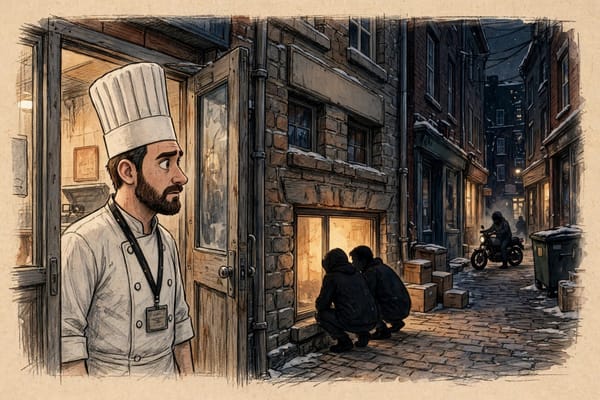
Off the Menu #07 — Watched
Carbonara week: a cook reaches for the cream, the eggs keep scrambling — and late one night, Daniel finds two people at the basement window, faces to the glass. A third is watching from the alley.
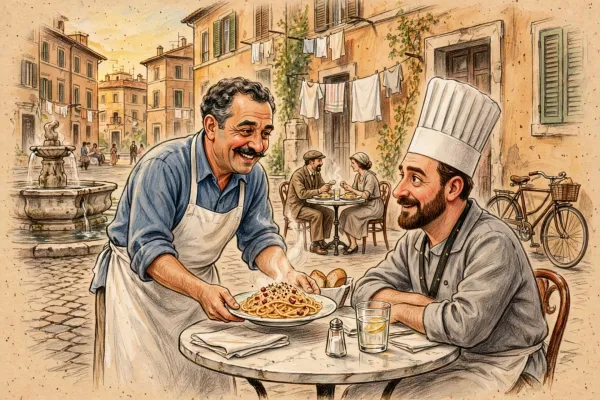
Episode 7 — Carbonara Origin: The True Story (Rome, 1939)
Carbonara was on a Roman menu in 1939 — five years before the American rations it's blamed on. The charcoal myth, the general's dinner, the gruyère scandal, and the rules that arrived last.
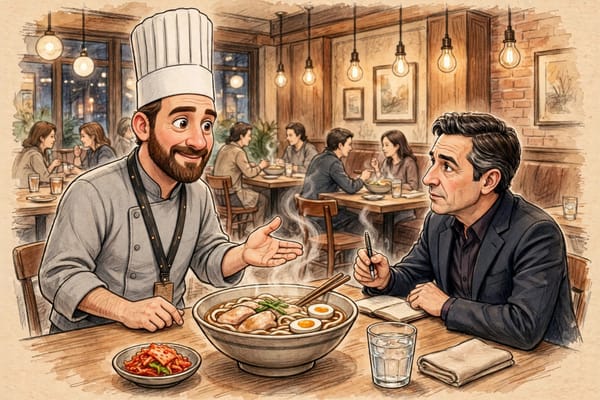
Off the Menu #06 — Table Twelve
Kimchi week brings a new chicken udon, a full dining room — and a food critic at table twelve who finishes the whole bowl. Later, the book's amber-ringed page gains a garnish.