
Episode 6: Kimchi Origin — The True Story Behind the Ferment
Kimchi's jar is 2,000 years old. Its fire is 200. Its cabbage is younger than the Eiffel Tower. The true story of Korea's ferment — and the myths it outlived.

Friday morning, I came in early — before the crew, before the deliveries, before the coffee had decided what it was.
All night I'd been tasting it. Not dreaming. Tasting. The kimchi from last night's team dinner at the Korean restaurant, still sitting at the back of my tongue like it had moved in. Red, alive, older than the restaurant and younger than everything I assumed about it. And under it, my own jar — the one waiting in the basement since October. The jar I still don't remember making.
I went straight down. The book was on the worktable, where I'd left it last night. Still open to the red page. The thumbprint at the corner — the one I didn't put there — had dried overnight to a dark red-brown, like old paint.
The jar beside it ticked once, softly. Fermenting things breathe. Books shouldn't.
I pressed my own thumb next to the print to compare the size.
Then the basement was a garden, the air was summer, and a man was lifting salted radish out of an earthenware jar with the concentration of a poet — which, it turned out, he was.
The garden
Goryeo. Eight hundred years ago, give or take. The poet's name was Yi Gyubo, and he wrote about his garden the way chefs talk about their walk-ins — with pride and inventory. Six vegetables. Among them, radish: sliced and pickled for summer, preserved in salt for winter, "a side dish from start to end."
I looked in the jar. Radish, salt, brine. I looked for the rest of it — the red, the fire, the garlic punch. Nothing. The pickle was pale, mild, refreshing. It tasted like a cucumber's serious cousin.
"Where's the chili?" I asked.
Blank looks. There was no word for what I was asking. There was no chili in Korea. There was no chili anywhere east of an ocean nobody here had crossed, in a hemisphere nobody here knew existed. The pepper was still in the Americas, and it would stay there for another four hundred years.
This was kimchi's ancestor: vegetables, salt, time, and a clay jar. The fire I was tasting in my own basement, in my own century, was an immigrant that hadn't arrived yet.
The book agreed. The page turned itself.
The pepper
Four centuries later, and the strange red pods were the talk of the scholars. Yi Su-gwang, compiling his encyclopedia Jibong yuseol in 1614, wrote down the foreign thing: nammancho — "southern barbarian pepper" — so hot, he noted, that mixed into liquor it could kill a man.
How it got to Korea, nobody could tell me straight. One man swore it came with the Japanese invasions, in the ashes of the Imjin War, twenty years before. Another said traders, Portuguese ships, the long road through China. Both said it with total confidence. The documents, I would learn later, prove neither — only that by 1614, the pepper was here, feared and fascinating, a medicine and a curiosity.
And still — nobody was putting it in the kimchi. I watched a household salt its radishes the same way Yi Gyubo's had been salted, four hundred years on. The pepper sat in its pouch like a loaded rumour. The jar stayed pale.
Traditions don't change when a new ingredient arrives. They change when a generation decides the old way tastes like it's missing something.
The book agreed. The page turned itself.
The farmhouse
The late 1800s, and I could smell it before I saw it: fermented seafood, garlic, and — finally — the red.
A farmhouse kitchen in full production. The paste was scarlet now, ground dried chilies worked into the seasoning until the whole bowl glowed. Jeotgal — fermented shrimp, anchovy — went in by the ladle, funky and deep. The recipes on the page I glimpsed would have made sense to any Korean cook alive today: ponytail-radish kimchi, stuffed cucumbers, mixed pickles bright with chili.
Two hundred years after the pepper arrived, it hadn't just joined the kimchi. It had taken over. The pale jar of Yi Gyubo's garden was now the exception, the mild white kimchi served to children and grandmothers and people recovering from fevers.
But one thing was still wrong. I picked up a cabbage — loose, leafy, open-headed, more like a sturdy lettuce than the tight green cannonballs I salt by the case. The paste went on vegetables like this. It couldn't yet go into a whole cabbage, leaf by stuffed leaf, because that cabbage didn't exist here yet.
It was coming, though. From China. On the same kind of trade winds that had brought the pepper.
The book agreed. The page turned itself.
The new cabbage
Same decades, one more arrival. The new cabbage was a marvel and everybody knew it: tight-headed, heavy, sweet, bred in China and carried into Korea within living memory. Baechu. For the first time, a cook could salt a whole head until it went supple as cloth, then reach between every leaf with red paste and fold the whole thing around itself like a parcel.
I watched a cook do it — unhurried, exact, leaf by leaf — and realized I was watching the invention of the most famous kimchi on earth. Not in deep antiquity. Not three thousand years ago. Within a generation of the first automobiles. The cookbook of the era, Siuijeonseo, wrote this whole-cabbage kimchi down in its current form for the first time, the way you write down something new enough to need explaining.
The reddest, oldest-looking dish in Korea is one of its newest inventions. The jar is ancient. The fire is middle-aged. The cabbage is younger than the Eiffel Tower.
The book agreed. The page turned itself.
Kimjang
Late autumn, and the year turned on one weekend.
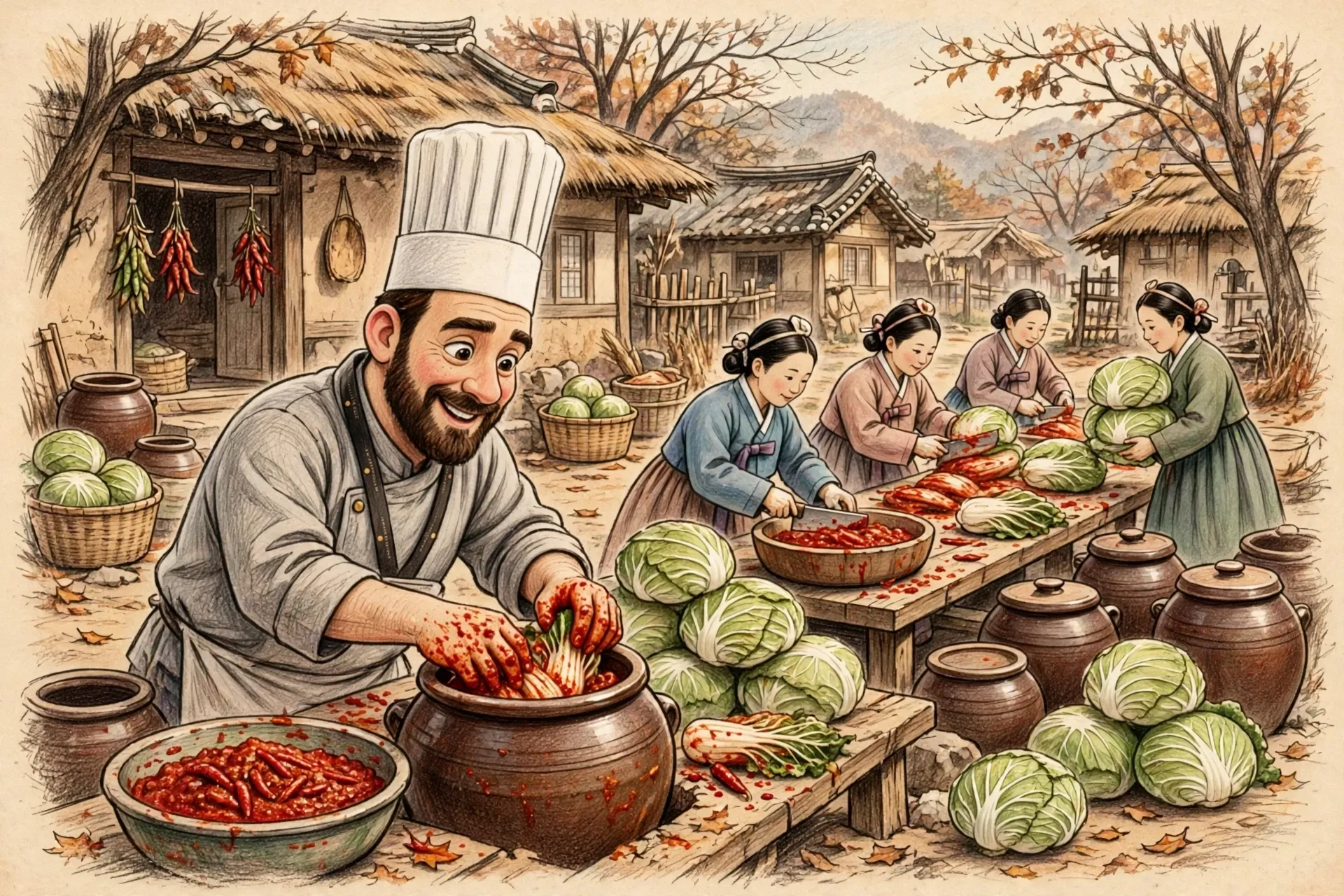
A courtyard full of cabbages — hundreds of them, salted and rinsed and stacked like a harvest festival. Every woman in the family, half the neighbours, sleeves rolled, bowls of red paste the size of washbasins. This is kimjang: not a recipe, a season. The whole winter's kimchi, made in a few days, together, because the cold was coming and the garden was ending and this is how a household eats vegetables in February.
They put me to work without asking who I was. Salt. Rinse. Taste the paste — more jeotgal. Pack the jars tight, no air, lids weighted. The great earthenware onggi went into the ground itself, buried to the neck in the yard, where the earth would hold them at the edge of freezing all winter — cold enough to slow the ferment to a crawl, warm enough to keep it alive.
Spring's shrimp, salted and fermented. Summer's sea salt. Late summer's chilies, dried and ground. All of it had been preparation for this weekend. A year's cycle, ending in a courtyard, in red handprints on cabbage leaves.
I looked down at my own hands, stained scarlet to the wrist.
Red thumbprints. Everywhere. Made by everyone who'd ever packed a jar properly.
The book agreed. The page turned itself.
The record
The origins. Fermented vegetables in Korea are documented, not just claimed. The Samguk Sagi (compiled 1145) mentions a pickle jar for fermenting vegetables in the Three Kingdoms period — evidence the practice is at least 1,500–2,000 years old, which is not the same as evidence for the modern dish. The first clear literary description is 13th-century: Yi Gyubo's poem on his garden vegetables, radish pickled for summer and salt-preserved for winter. Goryeo-era kimchi was one or two vegetables in salt — radish, cucumber, garlic chives — stored in earthenware onggi. No chili. No napa cabbage. Early records don't even mention garlic. The closest living relative of that original is white kimchi, baek-kimchi (Katarzyna J. Cwiertka, Encyclopedia of Food and Culture, 2003).
The chili. Chili peppers are a New World crop. They reached East Asia through Portuguese trade, and the first Korean mention is Yi Su-gwang's Jibong yuseol (1614), describing nammancho as nearly lethal. The beloved story that chili arrived with the Japanese invasions of 1592–98 is a traditional attribution with no direct document behind it — believable, unproven. Three dates get conflated into one myth, so keep them separate: chili reaches Korea around 1600; chili enters kimchi in the 1700s (farm texts like Sallim gyeongje describe it; Cwiertka dates the addition to about the mid-18th century); chili dominates kimchi in the 1800s, when recipes start matching today's. Fermented seafood (jeotgal) joins even later — late 19th century — and drives the regional explosion of styles.
The cabbage. Napa cabbage (baechu) was introduced from China only at the end of the 19th century. Before it, "cabbage kimchi" meant loose leafy greens. Whole-cabbage kimchi in its current form is first described in Siuijeonseo (c. 1890s). The iconic red parcel — the image the whole world calls kimchi — is roughly 120–140 years old and became the default only in the early-to-mid 20th century.
Kimjang. The communal late-autumn make is the practice, distinct from the food. UNESCO inscribed "Kimjang, making and sharing kimchi in the Republic of Korea" on its Intangible Cultural Heritage list in 2013 — North Korea received its own listing in 2015. UNESCO documents the full annual cycle: jeotgal procured and fermenting in spring, sea salt bought in summer, chilies dried and ground in late summer, kimjang in late autumn, know-how passed from mother-in-law to daughter-in-law. South Korea marks Kimchi Day on November 22 (designated 2020).
The science. A jar of kimchi is a relay race. Lactobacillus sakei shows up early; Leuconostoc species drive the prime ripening phase, making the acid, the faint sparkle of CO₂, and a touch of sweetness; acid-tolerant Lactobacillus plantarum takes over as it sours; Weissella koreensis — a species named for this food — arrives late, faster in warm ferments (Cho et al., 2006, FEMS Microbiology Letters, 970 isolates; Journal of Applied Biological Chemistry, 2020). Temperature conducts the whole orchestra: at its best, kimchi sits around pH 4.2–4.6, and the jar reaches pH 4.2 in about 2 days at 25 °C — or about 23 days at 5 °C. That's the buried onggi in one number: cold stretches two days of ripening into three weeks. Salt, acid, low oxygen, and cold together are why kimchi doesn't rot — it over-ferments instead, gets too sour, and goes into the stew pot. Overripe is a stage, not a failure.
The name, defended. In 1988, kimchi was an official food of the Seoul Olympic Village — organizers were so worried about the smell that staff were told to brush their teeth after eating it. The world tried it anyway, and exports surged. In 2001, after years of argument with Japanese producers whose unfermented kimuchi Korea refused to accept as the same food, the Codex Alimentarius adopted an international standard — under the name "kimchi" (CXS 223-2001) — defining it by exactly the thing that separates it from pickles: lactic fermentation at low temperature. In 2008, kimchi went to orbit with Yi So-yeon, Korea's first astronaut — sterilized by gamma radiation, bacteria-free, which is the paradox of the century: a food whose entire point is its living bacteria, sent to space with the life removed for safety. And in 2020, when a Chinese state newspaper hailed an ISO standard for Sichuan pao cai as a win "for the kimchi industry," the fight turned out to be over a headline — the ISO text itself says it does not apply to kimchi, and Seoul pointed back to the 2001 Codex definition. In 2021, Korea's culture ministry changed kimchi's official Chinese rendering from pao cai to a coined word, xinqi — "spicy and unique" — so the name, at least, would stop being borrowed.
The health claims, graded. Solid: kimchi is a low-calorie, high-fibre vegetable dish that carries live lactic-acid bacteria when unpasteurized. Weak: the weight-loss and metabolic claims rest on small, short trials; the cancer claims rest mostly on cells and rodents fed extracts. The counterweight nobody quotes: kimchi is salty, and high-salt diets are a real gastric-cancer risk factor — the honest evidence has the dish in both columns at once. And beware the legend tier entirely: in 2003, a rumour that kimchi prevented SARS — a claim with zero evidence — was credited with driving record exports. In 2005, a much-quoted bird-flu claim rested on 13 chickens fed kimchi extract, a study never properly published. Thirteen chickens is an anecdote with a lab coat.
How many kimchis? Not one dish — a family. The World Institute of Kimchi counts over 250 types, more than 1,000 under finer classification: white water kimchis with no chili at all, cucumber kimchi, cubed-radish kkakdugi, greens, roots, even seafood. Baechu-kimchi is the famous one. It is not the only one — and for most of history, it wasn't even the red one, because there was no red one.
Verdict: Kimchi is a two-thousand-year-old way to keep vegetables alive through winter that got its colour from America, its cabbage from China, and its name defended in Geneva — the reddest, oldest-looking dish in Korea is one of its newest inventions.
I came back standing in the basement, thumb still pressed to the page, the jar ticking beside me like it approved.
Upstairs, service was starting without me. I opened the jar — my jar, whoever made it — and tasted. Sour, alive, exactly at the edge where fermentation turns from bright to serious. Ready. It had been ready, I suspect, for exactly as long as it took me to go and learn what it was.
"Marco. Napa cabbages — whole cases. Radishes. Gochugaru, the good flakes, not the dust. Fish sauce. And clear me counter space — this one is made by hand, leaf by leaf."
Then I took the chalk, wiped "TURKEY, 1621(?)" off the board, and wrote:
KIMCHI, 1200s(?)
The question mark is doing a lot of work again. This time it's carrying eight centuries of white kimchi nobody photographs.
Chef's note — Daniel's working version
Kimchi is a process, not a recipe. Salt, seasoning, fermentation, time. Get the process right and the variations are endless. Get it wrong and you've made expensive compost.
Salt the cabbage properly. Halved or quartered napa, salted at roughly 2–3% — or brined — for 8 to 12 hours, until a leaf bends without snapping. Under-salt it and it goes mushy and bland; over-salt it and the ferment never wakes up. Rinse two or three times, drain well. Wet cabbage makes watery kimchi.
Build the paste like you mean it. Gochugaru — flakes, not powder, for texture and colour — garlic, ginger, fish sauce or fermented shrimp for the deep note, a little sugar or grated pear to feed the bacteria and round the heat. A spoon of sweet rice porridge is the old trick: it gives the paste body and gives the bacteria a first meal. Gloves on. Your hands will be red for two days otherwise, and everything you touch will know where you've been.
Pack it tight. The enemy is air. Press the seasoned cabbage into the jar so the brine rises over it, leave headroom — it will bubble — and walk away. One to two days at room temperature until it's bright and just starting to tang, then into the cold. Cold is the brake pedal; use it. Taste as it goes: fresh and fiery in week one, perfectly sour around pH 4.2, and when it goes past ripe, don't you dare throw it out — that's jjigae kimchi, fried-rice kimchi, the cook's reward.
And respect the jar. Every culture that survives winter has one. This one just happens to be red.
Quick facts
- Origin: Korea — salted vegetables documented by the Three Kingdoms era; first clear description is Yi Gyubo's salted radish, 13th century. The modern red napa version dates only to the late 1800s.
- Key ingredients: Napa cabbage (or radish, cucumber, greens), salt, gochugaru, garlic, ginger, jeotgal (fermented seafood).
- Defining technique: Salt to draw water, season leaf by leaf, pack air-free, ferment cool — lactic-acid bacteria do the rest.
- Surprising details: There are 250+ documented types of kimchi, most of history's kimchi was white, and the version that went to space in 2008 had to be sterilized — bacteria-free kimchi, which is to say, kimchi with the kimchi removed.
The board says KIMCHI, 1200s(?). The first jars are packed, the counter looks like a crime scene in the best way, and the whole kitchen smells like garlic and intention.
But tonight, closing up, the book was open on the worktable again — past the red page, to one I hadn't seen. No drawing this time. Just a ring, printed faint and amber on the paper, like the ghost of a glass set down by someone in no hurry.
Under it, the page smelled of orange peel. And burnt sugar. And something with rye in it.
The next page is already turning.
 KossMass

Never miss an issue
Get the next secret history first
One story a week. No recipes, no spam — just the real history behind what we eat and drink.
Keep reading

Off the Menu #07 — Watched
Carbonara week: a cook reaches for the cream, the eggs keep scrambling — and late one night, Daniel finds two people at the basement window, faces to the glass. A third is watching from the alley.
Episode 7 — Carbonara Origin: The True Story (Rome, 1939)
Carbonara was on a Roman menu in 1939 — five years before the American rations it's blamed on. The charcoal myth, the general's dinner, the gruyère scandal, and the rules that arrived last.
Off the Menu #06 — Table Twelve
Kimchi week brings a new chicken udon, a full dining room — and a food critic at table twelve who finishes the whole bowl. Later, the book's amber-ringed page gains a garnish.